



The World's Largest Telescope
The Square Kilometre Array (SKA) isn't a single telescope but a global scientific endeavour to build the world's largest and most sensitive radio observatory. To achieve its ambitious goals, the SKA is split across two remote, radio-quiet continents.
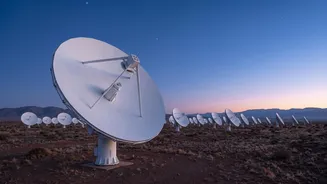
In South Africa’s Karoo region, an array of 197 classic dish-shaped antennas, known as SKA-Mid, is taking shape. Simultaneously, in Western Australia, on the traditional lands of the Wajarri Yamaji people, an array of 131,072 smaller, Christmas-tree-like antennas called SKA-Low is being constructed. These locations were chosen specifically for their remoteness, protecting the hyper-sensitive instruments from radio frequency interference generated by our modern electronic world. Together, these two arrays will operate as a single, colossal instrument, poised to revolutionise our understanding of everything from the birth of stars to the nature of gravity.
How a Radio Antenna Listens
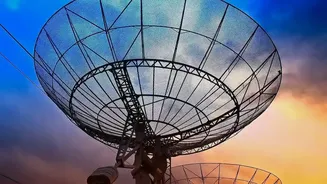
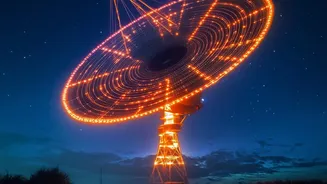
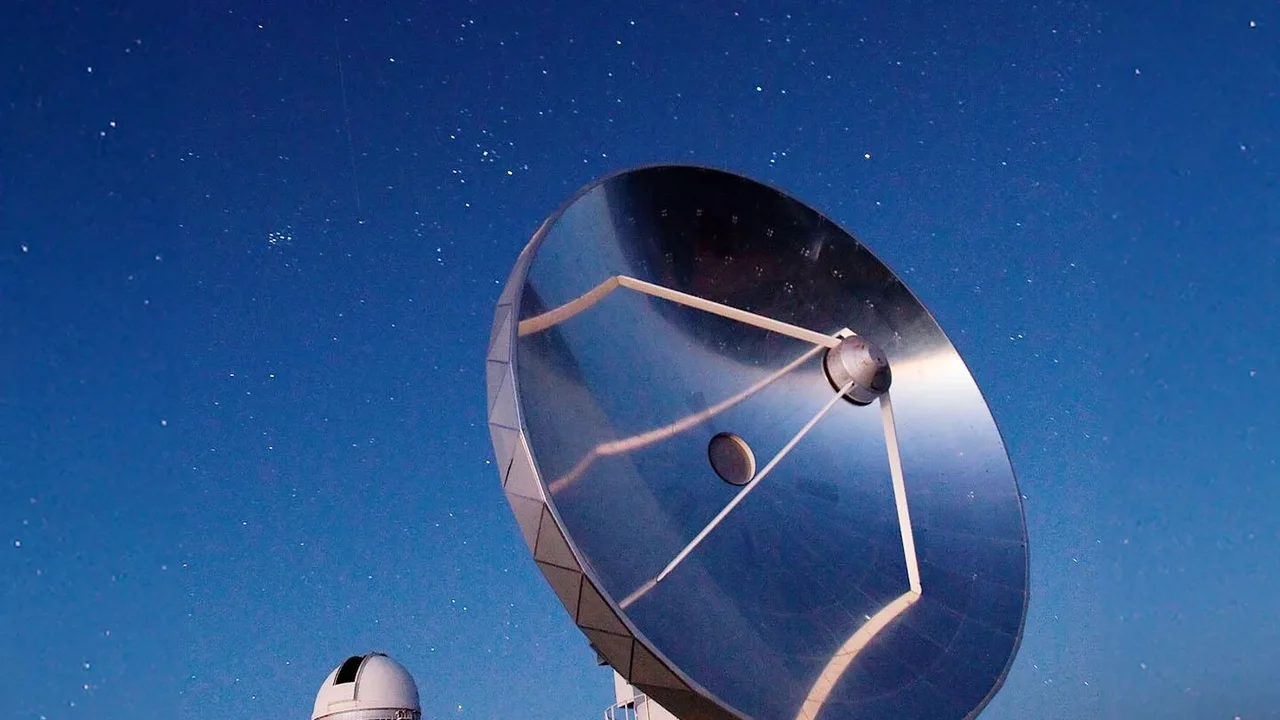
Unlike optical telescopes that see visible light, radio telescopes capture long-wavelength radio waves emitted by cosmic objects. These signals are incredibly faint—it's said the total energy collected by all radio telescopes in history is less than the energy of a single falling snowflake. An SKA-Mid dish works like a giant bucket for these waves. Its 15-metre parabolic surface collects the incoming radio signals and reflects them to a precise focal point where a highly sensitive receiver is located. This receiver converts the weak radio waves into electrical signals, which can then be digitised and analysed. The SKA-Low antennas in Australia work differently. They are stationary dipoles designed to be highly efficient at picking up low-frequency radio waves, the very ones that have travelled for billions of years and been stretched out by the expansion of the universe.
The Power of an Array
So why not just build one enormous dish? The real power of the SKA comes from a technique called interferometry. By linking thousands of antennas over vast distances—up to 150 km in South Africa—astronomers can create a 'virtual' telescope with a collecting area equivalent to its largest separation. This gives the observatory its incredible sensitivity and resolution, allowing it to see fainter objects in finer detail than ever before. To make this work, every signal from every antenna must be time-stamped with mind-boggling precision using atomic clocks. The signals are then combined by supercomputers, which correct for the tiny delays as the radio waves arrive at each antenna at a slightly different moment. This process of combining signals allows astronomers to build up a detailed picture of the radio sky.
Tuning into the Cosmic Dawn
One of the SKA's primary missions is to look back in time to a period known as the Cosmic Dawn and the subsequent Epoch of Reionisation. This was the universe's infancy, about 50 to 100 million years after the Big Bang, when the very first stars and galaxies were beginning to form and light up the cosmos. The SKA is designed to detect the faint radio signal emitted by neutral hydrogen, the most abundant element in the early universe. This signal, known as the 21-cm line, was originally emitted at a frequency of 1420 MHz, but the expansion of the universe has stretched it to the low frequencies that SKA-Low is designed to detect. By mapping the distribution of this hydrogen gas over time, scientists can create a 3D picture of how the first luminous structures ignited and gradually ionised the neutral gas around them, transforming the dark universe into the one we know today.
A Tsunami of Data
Capturing these ancient signals is only half the battle; the other is processing the data. The SKA is considered one of the ultimate 'Big Data' challenges. The raw data flowing from the telescopes to the central processing facilities in Perth and Cape Town will be on the order of 8 terabits per second—thousands of times faster than typical home broadband speeds. This data deluge requires two of the world's fastest supercomputers to correlate, calibrate, and transform the raw signals into scientifically useful images and data products. These Science Data Processors will perform an estimated 135 petaflops, or 135 quadrillion calculations per second. The observatory will ultimately archive over 700 petabytes of data each year, which will be distributed to a global network of regional centres for astronomers to access and analyse.