


The Martian Meal Problem
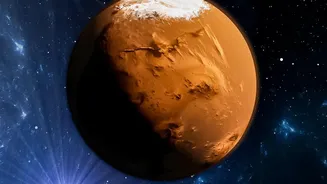
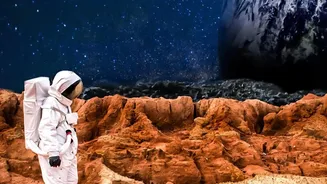
Before we can establish a foothold on Mars, we need a reliable way to eat. Packing enough food for a multi-year mission is not feasible due to weight and space limitations on spacecraft. The next logical step would be to grow food on-site, but Mars presents
a formidable set of challenges. Its 'soil' is technically regolith—crushed rock with no organic matter, microbes, or nutrients essential for plant life. Worse, it’s laced with toxic perchlorate salts. Beyond the soil, the environment itself is hostile. The planet's thin atmosphere, lack of a protective magnetic field, and greater distance from the sun mean plants would be exposed to intense radiation, freezing temperatures, and insufficient light. Simply planting a potato in the ground, as seen in fiction, isn't a viable option without significant intervention.
What is Hydroponics, Anyway?
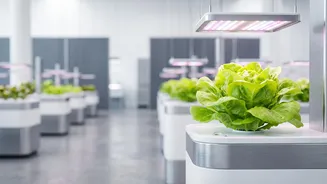
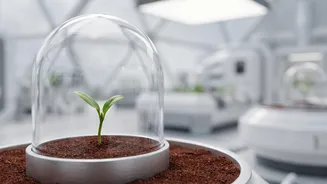
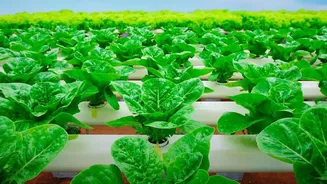
Enter hydroponics, a method of growing plants without soil. Instead of rooting in dirt, plants are suspended in a structure where their roots are directly exposed to a nutrient-rich water solution. This technique gives growers complete control over the plant's environment—from the exact nutrients it receives to the temperature and light exposure. On Earth, hydroponics is already used to produce crops like lettuce, tomatoes, and herbs with high efficiency. Because the systems are closed-loop, they can use up to 90% less water than traditional agriculture, a key advantage in any resource-scarce environment. They also allow for vertical farming, stacking plants to maximize yield in a small footprint.
A Greenhouse on the Red Planet
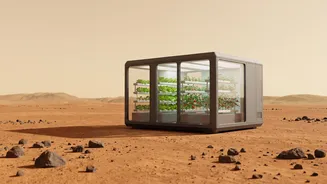
On Mars, hydroponics would operate inside a pressurized and heated greenhouse, immediately solving the problems of atmosphere and temperature. This enclosed system would shield plants from harmful radiation and provide a controlled environment where everything from humidity to light can be optimized for growth. By sidestepping Martian regolith entirely, hydroponics eliminates the issue of soil toxicity and the need for complex processing. Furthermore, these systems are a key component of bioregenerative life support. Plants would absorb the carbon dioxide exhaled by the crew and release oxygen through photosynthesis, helping to create a breathable atmosphere and reducing the need to transport heavy oxygen tanks from Earth.
Not Without Its Challenges
While hydroponics solves many problems, setting one up on Mars introduces new ones. The biggest hurdles are power and water. These systems require significant energy to run pumps, maintain temperature, and power specialized LED lights to supplement the weak Martian sunlight. One potential solution is a Multi-Mission Radioisotope Thermoelectric Generator (RTG), a plutonium-based power source more reliable than solar panels, which can be obscured by Mars's frequent dust storms. Water, though present on Mars as ice, must be mined and purified—a major undertaking. However, the high efficiency of hydroponic systems means that once the initial water supply is established, it can be continuously recycled with minimal loss.
Lessons from Earth and Space
This isn't just theory. NASA has been actively researching and implementing hydroponics in space for years. Experiments like the Vegetable Production System (Veggie) and the Advanced Plant Habitat aboard the International Space Station (ISS) have successfully grown lettuce, radishes, and even chili peppers in microgravity. These projects provide crucial data on everything from water delivery in zero-G to the psychological benefits for astronauts of tending to living plants. Researchers are also using this data to design scalable systems for longer missions. One concept, the Rotating Hydroponic Production Unit (RHPU), is a modular design that could be scaled up to feed an entire crew, demonstrating that serious architectural and logistical planning for Martian farms is well underway.