


The Downhill Dilemma
Running or hiking on varied terrain is one of the best ways to challenge your fitness. However, the descent is often where knee issues begin. When you move downhill, your body must constantly brake to control your speed and absorb impact. This braking
action places a massive eccentric load on your quadriceps muscles and, by extension, the patellar tendon. The patellar tendon connects your kneecap to your shinbone and acts like a rope, transferring force from your quads to extend your knee. During downhill movements, this tendon is forced to lengthen while under significant tension, a motion that can lead to micro-trauma. Over time, if the load exceeds the tendon's ability to repair itself, it can lead to patellar tendinopathy, a condition often called 'jumper's knee'. This isn't just simple inflammation; it's a degenerative change in the tendon's structure, where organized, strong collagen fibers become disorganized and weak, causing pain right below the kneecap.
The Eccentric Solution
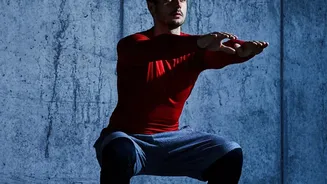
To fight eccentric load, you need eccentric strength. Muscular contractions come in two main forms: concentric, where the muscle shortens (like when you lift a weight in a bicep curl), and eccentric, where the muscle lengthens under load (like when you slowly lower that same weight). While downhill running forces an uncontrolled eccentric load on the tendon, specific exercises can apply a controlled, therapeutic load. This is where slow-eccentric squats come in. This exercise isolates the lengthening phase of the muscle contraction, focusing the stress in a deliberate and measured way. By slowly lowering your body into a squat, you are training the muscle-tendon unit to handle the exact type of force it encounters on a steep descent. The goal isn't to build massive muscle but to stimulate a healing and strengthening response directly within the tendon tissue itself, making it more robust and capable of handling future strain.
The Science of Tendon Repair
How does a controlled stress actually heal a tendon? The process is rooted in a biological principle called mechanotransduction. Think of it as a conversation between your movements and your cells. The specialized cells within your tendons, called tenocytes, act like tiny sensors. When you perform a slow-eccentric squat, the specific mechanical tension sends a signal to these tenocytes. This signal effectively tells them to get to work. In response, they ramp up the production of Type I collagen, the strong, fibrous protein that forms the primary structure of a healthy tendon. This new collagen helps to remodel the damaged areas, replacing weak, disorganized tissue with a strong, parallel fiber alignment. Over time, this targeted loading not only repairs the tendon but also increases its overall stiffness and capacity to store and release energy, making it far more resilient to the high-impact forces of your next hilly adventure.
How to Perform Slow-Eccentric Squats
Performing this exercise correctly is crucial for its effectiveness. While it can be done on a flat surface, using a slant board or a wedge (around 25 degrees) is highly recommended as it helps to better isolate the patellar tendon. 1. Positioning: Stand on the slant board with your feet shoulder-width apart, facing down the slope. If you only have pain in one knee, you will still perform the movement with both feet on the board, but you will shift your focus. 2. The Descent: Slowly begin to lower yourself into a squat, as if sitting back in a chair. The most important part is the tempo: take 3 to 5 seconds to complete the entire downward motion. If one leg is affected, consciously put slightly more of your weight onto that leg during the descent. 3. The Ascent: Once you reach a comfortable depth (aim for thighs parallel to the ground, but don't push into sharp pain), shift your weight almost entirely onto your unaffected leg and use it to push yourself back up to the starting position. The injured leg should do as little work as possible on the way up. 4. Repetitions: Aim for 3 sets of 15 repetitions, once a day. If you have pain in both knees, you can use your arms to help you push back up to standing.
Consistency and Caution
Tendon adaptation is a slow process, so consistency is more important than intensity. It can take several weeks or even months to notice a significant reduction in pain and an increase in strength. A small amount of discomfort during the exercise is generally considered acceptable and even productive for stimulating the tendon. However, you should never push through sharp, stabbing, or increasing pain. If the pain level rises significantly during or after your session, you should reduce the load or rest. Start with just your body weight. As you get stronger and the exercise becomes pain-free, you can add a small amount of weight, such as by wearing a backpack, to continue challenging the tendon. Listening to your body is key to ensuring the loading remains therapeutic rather than harmful.