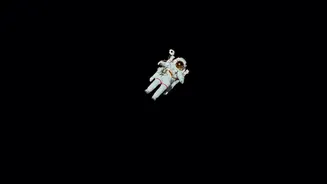







A World of Fire and Ice
Imagine floating in space. When the sun is shining on you, the temperature can soar to a blistering 121 degrees Celsius. But the moment you drift into shadow, the temperature plummets to a bone-chilling minus 157 degrees Celsius. On Earth, our atmosphere
acts like a blanket, moderating temperatures. In the vacuum of space, there is no air to transfer heat, leaving an astronaut exposed to these violent extremes. Without protection, a human body would be subjected to unbearable conditions. This is where the spacesuit, or Extravehicular Mobility Unit (EMU), proves to be a marvel of engineering, creating a tiny, habitable world for one.
Personal Air Conditioning
The first line of defence against temperature extremes starts right against the astronaut's skin. Before donning the bulky outer layers, they put on a Liquid Cooling and Ventilation Garment (LCVG). This snug, full-body undergarment, made of spandex and nylon, is threaded with approximately 300 feet of thin plastic tubing. Cool water continuously circulates through these tubes, absorbing the astronaut's body heat, especially during strenuous activity. This water is then pumped to a backpack unit called the Primary Life Support System (PLSS), where the heat is radiated away into space. This system essentially functions as a personal, wearable air conditioner, preventing the astronaut from overheating inside the heavily insulated suit.
The Power of Layering
A modern spacesuit is not a single garment but a complex assembly of up to 16 layers, each with a specific job. Immediately outside the LCVG is a pressure bladder, an airtight layer that holds in breathable oxygen and maintains the pressure needed to keep an astronaut alive in a vacuum. This is surrounded by a restraint layer that prevents the bladder from ballooning outwards. The true temperature-fighting hero, however, is the Thermal Micrometeoroid Garment (TMG). This outer section of the suit is itself composed of many layers. It includes multiple sheets of aluminised Mylar—the same reflective material found in emergency blankets—alternating with layers of a spacer fabric like Dacron. This combination works like a high-tech thermos, reflecting solar heat away and keeping the astronaut's own body heat in when they are in shadow.
A Tough Outer Shell
The final, outermost layer of the spacesuit is a single, tough fabric that provides the first line of defence. It is typically white to reflect as much solar radiation as possible. This layer is a specialised blend of materials, including Gore-Tex for waterproofing, Kevlar for puncture resistance, and Nomex for fire resistance. This robust shell, known as Ortho-Fabric on NASA's EMU suits, protects the delicate inner layers from abrasion and, crucially, from micrometeoroids—tiny particles of rock and debris that travel at incredible speeds and could otherwise puncture the suit. While insulation handles the cold, targeted heaters are also embedded in the gloves and boots to protect extremities from the intense freeze of space.