


Defining a Day and a Year
Before we dive into the Venusian conundrum, let's quickly recap our basic celestial mechanics. A 'year' is the time it takes for a planet to complete one full orbit around its star. For Earth, that’s roughly 365 days. A 'day' is the time it takes for a planet to complete one full rotation
on its own axis. For Earth, that's about 24 hours. On our planet, these two cycles create a familiar rhythm: we experience hundreds of sunrises and sunsets within a single trip around the Sun. We intuitively expect a year to be a much, much longer period than a day. This simple, fundamental assumption is what makes Venus so utterly strange.
The Venusian Anomaly by the Numbers
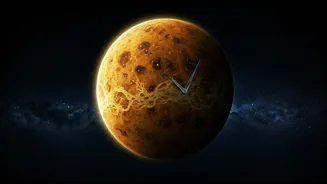
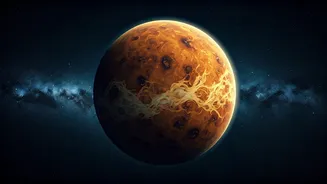
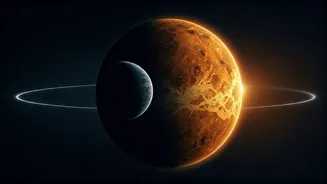
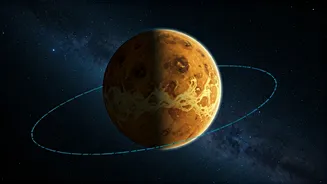
On Venus, the familiar relationship between a day and a year is turned completely on its head. Let’s look at the numbers in terms of Earth days to make sense of it. A Venusian year—the time it takes to orbit the Sun—is approximately 225 Earth days. This is shorter than our own year, which makes sense since it’s closer to the Sun and has a smaller orbit to travel. Here’s where it gets weird. A Venusian sidereal day—the time for one full rotation on its axis—is approximately 243 Earth days. You read that correctly. A single rotation of the planet takes longer than its entire journey around the Sun. On Venus, a day is literally longer than a year. It's the only planet in our solar system where this is the case.
A Planet Spinning the Wrong Way
What causes this temporal madness? The primary reason is Venus's incredibly slow and backward rotation. While most planets in our solar system spin counter-clockwise on their axis (the same direction they orbit the Sun), Venus spins clockwise. This is known as retrograde rotation. Not only does it spin backward, but it does so with agonising slowness. Imagine a spinning top that has almost run out of energy; that's Venus. Scientists are still debating the exact cause of this peculiar spin. One leading theory suggests a massive collision with a planet-sized object in its distant past could have knocked it off-kilter, slowing its rotation and eventually reversing it. Another theory points to a complex interplay between the Sun's powerful gravity and the planet's thick, heavy atmosphere, creating a tidal drag that gradually slowed and flipped its spin over billions of years.
Sunrise to Sunrise: A Different Story
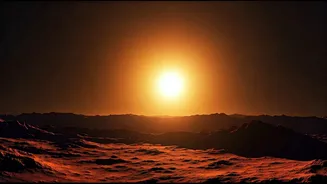
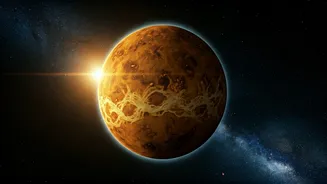
To add another layer of complexity, the day-longer-than-a-year fact refers to a *sidereal day* (one full 360-degree spin). If you were standing on the surface of Venus (which you wouldn't want to do—more on that later), what you would care about is the *solar day*: the time from one sunrise to the next. Because the planet is rotating backward while it orbits the Sun, these two motions work against each other in a way that actually shortens the solar day. The result is that a Venusian solar day is 'only' about 117 Earth days long. So, you would experience two sunrises for every one trip around the Sun, with each 'day-night cycle' lasting for nearly four of our months.
Earth's Hellish Twin
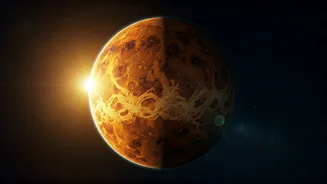
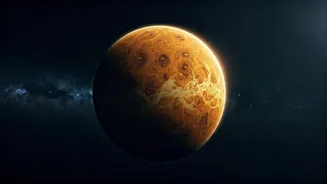
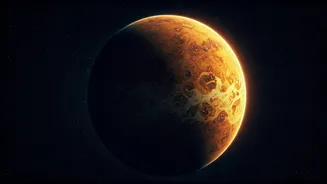
The strange calendar is just one of many hostile features of the planet often called 'Earth's twin' due to its similar size and mass. Venus is the hottest planet in the solar system, with surface temperatures averaging a staggering 465°C—hot enough to melt lead. Its atmosphere is over 90 times denser than Earth's, meaning the pressure on the surface is equivalent to being 900 metres underwater. This crushing, toxic atmosphere is made mostly of carbon dioxide, creating a runaway greenhouse effect that trapped heat billions of years ago. To top it all off, its clouds aren't made of water vapour, but of corrosive sulfuric acid. It's a vision of a paradise lost, a world that may have once been more like Earth but took a dramatically different evolutionary path.