




The Universe’s Densest Objects
Before we get to the dizzying spin, let’s talk about what a neutron star actually is. When a star many times more massive than our sun runs out of fuel, it collapses and then explodes in a spectacular event called a supernova. While the outer layers are
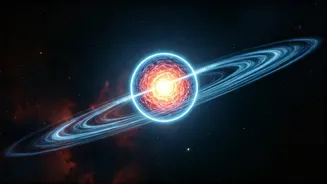
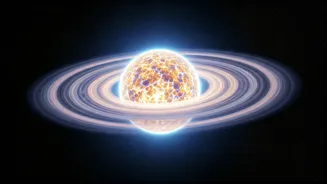
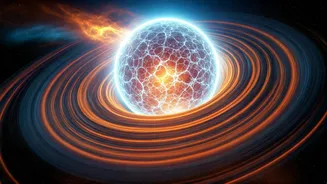
blasted into space, the star's core is crushed by its own gravity. Electrons and protons are squeezed together so intensely that they merge to form neutrons, hence the name. The result is an object so dense it defies comprehension. A single teaspoon of neutron star material would weigh about four billion tons on Earth—as much as a mountain. All this mass, roughly 1.4 times that of our sun, is packed into a sphere only about 12 miles (20 kilometers) in diameter. If you were to drop a marshmallow on a neutron star, it would hit the surface with the force of a thousand hydrogen bombs.
The Cosmic Ice Skater Effect
So, why the incredible spin? The answer lies in a principle called the conservation of angular momentum. It’s the same physics you see when an ice skater pulls their arms in to spin faster. The original star, while huge, was also spinning, albeit much more slowly. As the star’s core collapsed from a diameter of millions of miles down to just a dozen, all that rotational energy was conserved. Just as the skater’s speed increases dramatically when their mass is concentrated closer to their center of rotation, the neutron star’s spin rate skyrockets. It’s the universe’s most extreme example of the ice skater effect. A star that might have taken days or weeks to complete one rotation is now whipping around hundreds of times every single second.
Listening to a Cosmic Lighthouse
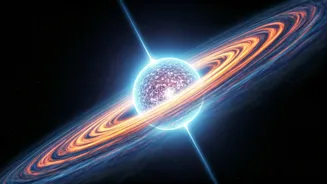
You might wonder how we could possibly measure something so far away spinning so fast. We don't see the star itself rotating like a top. Instead, we detect them as “pulsars.” Neutron stars have incredibly powerful magnetic fields, billions of times stronger than Earth’s. These fields funnel jets of radiation—like radio waves, X-rays, and gamma rays—out from the star’s magnetic poles. As the neutron star spins, these beams sweep across the cosmos like the beam of a lighthouse. If one of those beams happens to sweep past Earth, our radio telescopes pick up a regular, repeating “pulse.” By timing these pulses with atomic-clock precision, astronomers can calculate the star’s rotation period with stunning accuracy. Each pulse is one full rotation.
Is There a Cosmic Speed Limit?
While 600 times per second is mind-boggling, some neutron stars spin even faster. The current record holder, a pulsar designated PSR J1748-2446ad, rotates an incredible 716 times per second. That means a point on its equator is moving at over 20% the speed of light. But there is a limit. If a neutron star were to spin too fast, the centrifugal force at its equator would eventually become strong enough to overcome its own immense gravity. At that point, the star would start to shed mass and literally fly apart. Physicists estimate this cosmic speed limit is somewhere between 1,000 and 1,500 rotations per second. So far, we haven't found one pushing that absolute boundary, but astronomers are always listening for the next record-breaker.