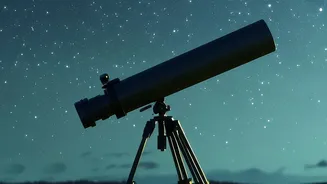







The Search for Dark Skies
In India's bustling cities, light and air pollution have rendered the night sky a blank canvas, with only the brightest planets and a handful of stars visible on a clear night. This has sparked a growing movement of urbanites seeking refuge under darker,
clearer skies. The phenomenon, often called 'astrotourism', is seeing a significant boom. People are increasingly willing to travel hundreds of kilometres not just for monuments or wildlife, but for an unobstructed view of the Milky Way. This desire for a cosmic connection is partly a search for digital detox and a reconnection with nature, a trend that accelerated after the pandemic made people yearn for open spaces. India's recent successes in space, including the Chandrayaan missions, have also ignited public curiosity in astronomy. Prime Minister Narendra Modi has even highlighted the growing popularity of astronomy clubs across the country, from big cities to small towns.
Your Planetarium in Your Pocket
What makes this trend so accessible is the technology right in our hands. Modern smartphone apps have democratised stargazing, an activity once reserved for serious hobbyists with expensive equipment. These apps act as a personal planetarium. Using your phone's GPS and compass, you can simply point it at the sky, and the app will identify the stars, constellations, planets, and even satellites passing overhead in real time. For beginners, this removes the biggest barrier to entry: the overwhelming feeling of not knowing what you're looking at. Suddenly, the sky is no longer a random scattering of lights but a map filled with stories, from the myths behind constellations to the science of distant galaxies.
Essential Apps for Indian Stargazers
Getting started is as simple as downloading an app. Many excellent options are free and perfect for beginners. Star Walk 2 is often recommended for its user-friendly interface and beautiful augmented reality overlays. Stellarium Mobile is another powerful tool, offering a vast catalogue of stars and deep-sky objects with realistic visuals. For a very simple and intuitive start, Google Sky Map remains a classic choice for Android users. And for those looking for an all-in-one experience, SkyView Lite provides great information and graphics for free. These apps not only identify celestial objects but also provide details about them, helping turn a simple viewing into a rich learning experience.
Planning Your Stargazing Weekend
Armed with an app, the next step is to escape the city glow. India is blessed with numerous locations perfect for stargazing. The key is finding a 'dark sky location' away from major urban centres. For Mumbaikars, Jawhar in the Sahyadri ranges is a popular escape just a few hours away. Similarly, those in Delhi can head towards the Sariska Tiger Reserve area. For residents of Bengaluru and Chennai, the hills of Coorg offer fantastic viewing opportunities. For the truly dedicated, destinations like the Spiti Valley in Himachal Pradesh, the Rann of Kutch in Gujarat, and Hanle in Ladakh (home to India's first Dark Sky Reserve) offer some of the darkest skies in the world. Before you go, check the moon phase—a new moon provides the darkest sky—and pack some warm clothes, as even desert nights can get chilly.