


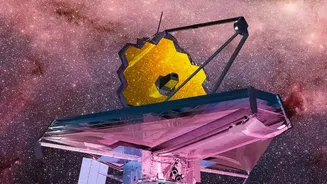
A New Cosmic Cartographer
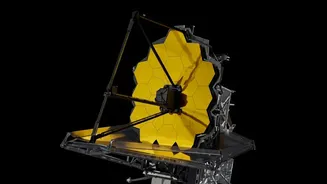
Named after Nancy Grace Roman, NASA's first Chief of Astronomy and the 'mother of Hubble,' the Roman Space Telescope is a mission designed for immense scale. While its 2.4-meter primary mirror is the same size as the Hubble Space Telescope's, its purpose
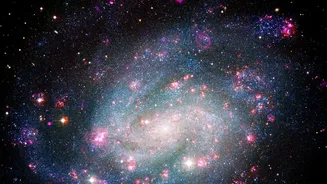
is fundamentally different. Instead of zooming in on specific cosmic targets, Roman is built to zoom out, surveying vast stretches of the sky with incredible speed and efficiency. Its mission is to create a massive map of our universe, charting the positions and shapes of billions of galaxies and stars to tackle some of the biggest questions in cosmology. The observatory successfully launched aboard a SpaceX Falcon Heavy rocket on August 30, 2026, and is now on its way to its operational orbit about 1.5 million kilometers from Earth.
The Power of a Wide-Angle View
The key to Roman’s galaxy-mapping prowess is its primary instrument: the Wide Field Instrument (WFI). This 300.8-megapixel camera gives the telescope a field of view 100 to 200 times larger than Hubble's infrared camera. Imagine trying to take a picture of a sprawling landscape. Hubble would be like looking through a keyhole, capturing exquisite detail in a tiny patch. Roman, by contrast, is like opening a massive panoramic window on that same scene. It will capture images with the same stunning sharpness as Hubble but across a much larger area. Where it might take Hubble hundreds of individual snapshots to map a region of the sky, Roman can achieve a similar result in just a couple of pointings, revolutionizing the speed at which cosmic surveys can be conducted.
Solving the Dark Universe's Mysteries
One of Roman’s primary directives is to investigate the 'dark universe'—the enigmatic forces of dark energy and dark matter that shape the cosmos. Dark energy is the mysterious force causing the expansion of the universe to accelerate, while dark matter is the unseen mass whose gravity holds galaxies together. Roman will tackle these mysteries by mapping the 3D structure of the universe over time. It will do this in several ways: by observing distant supernovae, which act as standard candles to measure cosmic distances; by mapping how galaxies cluster together across billions of light-years; and by studying weak gravitational lensing, where the light from distant galaxies is subtly distorted by clumps of dark matter. By analyzing these distortions across billions of galaxies, astronomers can create a detailed map of the dark matter scaffolding of the universe.
A Census of New Worlds
Beyond mapping distant galaxies, Roman is also a prolific planet-hunting machine. The mission is expected to uncover thousands of new exoplanets, adding significantly to the thousands already discovered. Its main technique will be gravitational microlensing. This method detects planets by observing the gravitational effect they, and their host stars, have on the light from a more distant, background star. This technique is sensitive enough to find planets of various sizes, including those with masses as small as Mars, and even free-floating 'rogue' planets not tied to any star. Additionally, Roman carries a technology demonstrator called a Coronagraph Instrument. This device is designed to block the overwhelming light from a star, allowing the telescope to directly image large, Jupiter-like planets orbiting nearby stars—a major technical feat.