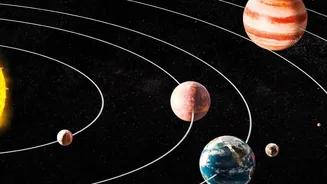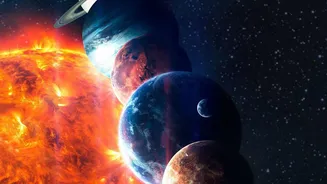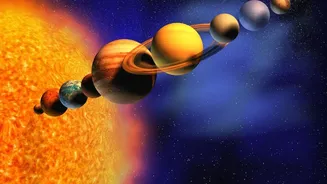






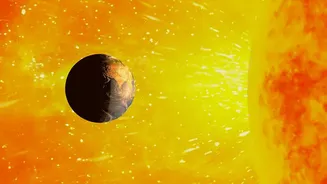
When we picture planetary rings, we think of Saturn’s magnificent, icy halo. But why are the inner planets—Mercury, Venus, Earth, and Mars—so bare? The answer may lie in our sun’s chaotic youth and a force powerful enough to blast them clean.
A Solar System Full of Rings
The early
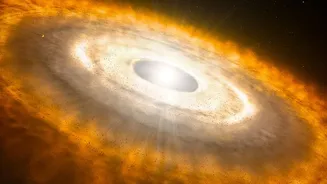
solar system, over four billion years ago, was a very different place. It began as a vast, rotating disc of gas and dust known as a protoplanetary disk, with a young, unstable star at its center. Within this cosmic nursery, gravity slowly pulled material together, forming the planets we know today. Scientists widely believe that during this formation process, all planets, including the inner terrestrial worlds, would have had their own systems of rings made from the leftover dust and debris. Much like the gas giants, these newly formed rocky planets would have been surrounded by orbiting material. Recent studies even suggest Earth may have had a temporary ring system as recently as 466 million years ago, formed from a shattered asteroid. The question, then, is not whether they ever had rings, but where those rings went.
The Sun's Violent Youth
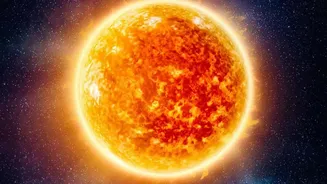
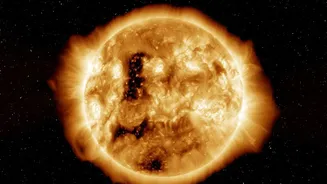
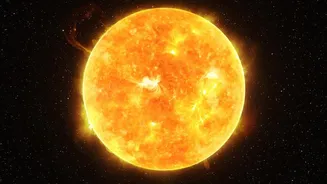
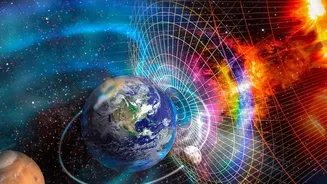
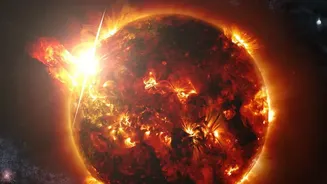
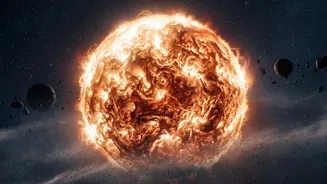
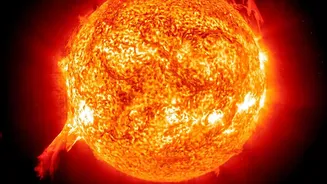
The key to this planetary mystery lies with our own sun. In its infancy, the Sun was not the stable star we know today. It went through a phase known as the T-Tauri stage, characterized by intense activity and an extremely powerful solar wind. This solar wind was a relentless stream of charged particles ejected from the Sun at incredible speeds, far more potent than what we experience today. This fierce stellar wind acted as a cosmic sandblaster, profoundly shaping the early atmospheres and environments of the planets closest to it. While planets with strong magnetic fields, like Earth, were partially shielded, the sheer force of this early solar wind had a dramatic impact on anything orbiting them.
Sweeping the Inner Planets Clean
The dust and small particles that would have comprised the rings of the inner planets were no match for this intense pressure. The solar wind would have effectively scoured the space around Mercury, Venus, Earth, and Mars, stripping them of their delicate ring systems. Lighter particles like dust and ice would have been pushed outward, away from the Sun, or vaporized by the high temperatures. The closer a planet was to the Sun, the stronger this effect. The immense radiation and particle pressure would have made it impossible for a stable, long-lasting ring of fine material to survive in the inner solar system. While gravity might pull debris into a ring, the solar wind would have relentlessly worked to blow it away.
Why the Outer Planets Kept Theirs
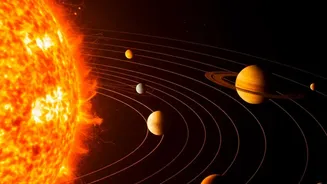
So why did Saturn, Jupiter, Uranus, and Neptune get to keep their majestic rings? The answer is distance and composition. Being much farther from the Sun, the solar wind that reaches the outer planets is significantly weaker and has less of an impact. Furthermore, their rings are largely composed of ice, not just dust. In the frigid depths of the outer solar system, ice particles can persist without vaporizing. The giant planets also have much stronger gravitational fields and possess numerous moons, some of which, known as 'shepherd moons', help to gravitationally contain and stabilize the ring material. These factors combined to create a stable environment where rings could form and persist for billions of years, a luxury the rocky inner planets simply never had.