




The Drag of Low Orbit
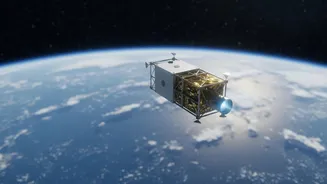
Satellites in Very Low Earth Orbit (VLEO), typically below 400 kilometres, face a persistent problem: atmospheric drag. While the air is incredibly thin, it’s still dense enough to slow spacecraft down, causing their orbits to decay. To counteract this,
satellites must fire thrusters to boost their altitude. Traditionally, this requires carrying a finite amount of propellant, like xenon gas. Once the propellant runs out, the mission is effectively over, and the satellite eventually falls back to Earth and burns up. This fundamental limitation has restricted the duration and scope of missions in these commercially and scientifically valuable low altitudes.
A Revolutionary Solution: Inhale and Thrust
Imagine a jet engine, but for space. That's the core idea behind air-breathing electric propulsion (ABEP), or as it's also known, ram-EP. Instead of carrying its own propellant, an ABEP system is designed to scoop up the scarce air molecules from the upper atmosphere and use them as fuel. This ingenious approach turns the very force that causes orbital decay—atmospheric drag—into a source of fuel, enabling a satellite to stay in orbit for years on end, potentially indefinitely. The only real limit becomes the lifespan of the satellite's electronic components, not its fuel tank.
How It Works: Scooping and Zapping
The process is elegant in its concept. As the satellite speeds through its orbit at roughly 7.8 kilometres per second, a specially designed intake collects the incoming atmospheric particles—mostly nitrogen and oxygen. These particles are guided into a chamber where they are ionized, meaning they are given an electrical charge. This is where the "electric" part of the thruster comes in. Using power generated by the satellite's solar panels, strong electric and magnetic fields then accelerate these newly created ions and shoot them out the back at extremely high velocity. This expulsion of ions generates a small but continuous thrust, perfectly countering the force of atmospheric drag and keeping the satellite stable in its orbit.
From Theory to Reality
This technology is no longer just a theory. The European Space Agency (ESA), in collaboration with industry partners like the Italian company Sitael, has successfully built and tested a prototype. In ground-based vacuum chambers that simulate the environment of a 200-km altitude orbit, they proved the concept works. During tests, the engine was first run on xenon, but the team then successfully transitioned to using a nitrogen-oxygen mixture, the main components of air. The visual cue for success was the engine's plume changing from the typical blue of xenon to a distinct purple, confirming it was indeed running on air. Further developments are underway, with projects aiming to refine the technology and prepare it for flight.
The Future of Sustainable Space Flight
The implications of air-breathing electric propulsion are vast. Satellites in VLEO offer significant advantages, including higher-resolution imagery for Earth observation, lower latency for telecommunications, and reduced launch energy. ABEP technology unlocks the full potential of this orbital region by creating long-lived, sustainable missions. It also contributes to mitigating the growing problem of space debris. Since these satellites operate in orbits with higher drag, they will naturally de-orbit and burn up relatively quickly at the end of their mission without needing extra fuel for disposal manoeuvres. This technology could even be adapted for exploring other planets with atmospheres, like using the carbon dioxide on Mars as a propellant source.