









Defining the ‘Missing Middle’
For decades, career progression was a predictable journey: you start in an entry-level position, gain experience, move into a middle-management or senior specialist role, and eventually compete for top leadership. This middle layer was crucial. It was where
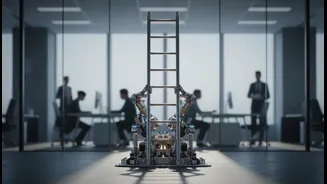
expertise was deepened, managerial skills were honed, and future leaders were nurtured. Today, this pathway is fracturing. The ‘missing middle’ refers to the hollowing out of these mid-career, mid-level jobs. These are roles that involve oversight, routine analysis, and process management — the very tasks that automation and AI are becoming exceptionally good at performing.
How Automation Creates the Gap
Technology is creating a polarised job market. On one end, there is a growing demand for high-level strategic thinkers, creatives, and technologists who can design and manage automated systems. On the other end, many low-skill, manual jobs that cannot be easily automated remain. The roles caught in the crossfire are those that are predictable and process-driven. Think of a senior analyst who spends their days compiling reports, a project manager tracking routine tasks, or an HR manager handling standard payroll and compliance. AI can now draft those reports, track progress via software, and manage payroll with minimal human oversight. This doesn't mean middle managers are extinct, but their roles are being fundamentally redesigned from supervisors to coaches and strategists. The result is a gap where the traditional stepping stones to a senior role used to be.
Which Roles Are Most Affected in India?
India’s thriving IT and business process outsourcing sectors, which created a massive middle class, are particularly exposed. Roles in basic coding, software testing, and back-office administration are facing immense pressure from automation. One estimate suggests that up to 40% of India's 4.5 million IT workers will need significant reskilling within the next five years. According to the International Labour Organisation (ILO), about 60% of formal employment in India is in 'middle-skill' jobs that are susceptible to automation, including clerical, sales, and service positions. This isn’t a distant threat; it’s a present-day challenge impacting millions of professionals who expected a clear path for advancement.
The Challenge for Companies and Employees
This trend creates a dual crisis. For companies, the 'missing middle' breaks their leadership pipeline. When mid-level roles vanish, there's no longer a natural training ground to prepare employees for senior responsibilities. This leads to a scramble for external hires and a disconnect between leadership and the on-ground workforce. For employees, the path forward becomes foggy and demoralising. After mastering their initial roles, they find no clear next step. This can lead to career stagnation, disengagement, and the feeling of being stuck, ultimately fuelling higher turnover as they search for growth elsewhere.
How Professionals Can Adapt and Thrive
The solution isn't to fight automation but to race ahead of it. For individuals, this means a deliberate shift in focus from performing routine tasks to developing uniquely human skills. These include critical thinking, complex problem-solving, emotional intelligence, creativity, and strategic decision-making. Becoming fluent in how to use and collaborate with AI tools is no longer optional. Professionals who can leverage technology to amplify their strategic insights will become invaluable. Continuous learning and upskilling are now the cornerstones of a resilient career; the goal is no longer to climb a ladder but to build a portfolio of adaptable skills.
The Responsibility of Employers
Companies cannot afford to be passive observers. Forward-thinking organisations are proactively redesigning career paths. This involves investing heavily in reskilling and upskilling programs to help their current workforce adapt. Instead of eliminating middle managers, they are transforming their roles into 'player-coaches' who guide teams, foster collaboration, and connect strategy to execution. They are creating new career lattices, where employees can move across functions to gain diverse experiences, rather than just moving up. This requires a fundamental shift from hiring for static job descriptions to investing in the long-term potential of their people.