



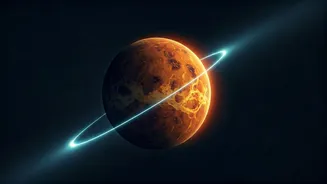


One Spin, 59 Earth Days
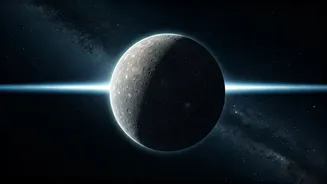
When we say a day on Mercury lasts 59 Earth days, we’re talking about its sidereal day—the time it takes to complete one full rotation on its axis. For comparison, Earth does this in about 24 hours. This means if you were standing on Mercury, it would
take nearly two of our months for the planet to spin around just once. This is an almost unbelievably slow pace for a planet, and it sets the stage for some truly strange celestial mechanics. But this 59-day spin is only one part of a more complex story. To truly understand a 'day' on Mercury, you also have to consider its 'year'.
A Year in Just 88 Days
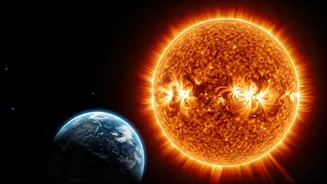
While Mercury spins sluggishly, it zips around the Sun at a blistering pace. A full orbit, or one Mercurian year, takes only about 88 Earth days. This combination of a slow spin and a fast orbit is the key to Mercury’s weirdness. This isn't a coincidence; it's a result of something called 'spin-orbit resonance'. The immense gravity of the Sun has tugged on Mercury for billions of years, slowing its rotation until it settled into a stable, rhythmic pattern. Specifically, Mercury is in a 3:2 spin-orbit resonance. This means that for every two orbits it completes around the Sun (two Mercurian years), it rotates on its axis exactly three times. This gravitational lockstep is the engine behind its bizarre calendar.
The Real 'Day': 176 Earth Days
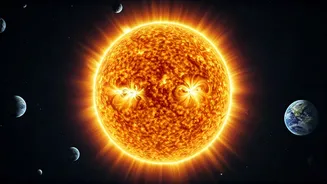
Here's where it gets truly mind-bending. While the planet spins once every 59 days, a full day-night cycle (what astronomers call a solar day, or the time from one sunrise to the next) on Mercury lasts a staggering 176 Earth days. How is this possible? Because the planet is moving so quickly in its orbit while it slowly rotates, the Sun appears to move very slowly across Mercury's sky. In fact, the solar day of 176 days is exactly two Mercurian years long (2 x 88 = 176). This means one full day on Mercury—from sunrise to sunrise—is longer than its entire year. You could celebrate two full birthdays during a single Mercurian day.
A World of Fiery Days and Frigid Nights
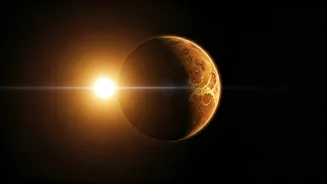
This ultra-long solar day has dramatic consequences. The side of Mercury facing the Sun gets baked for months on end. With no significant atmosphere to distribute the heat, surface temperatures can soar to a scorching 430° Celsius (800°F)—hot enough to melt lead. But the long night brings the opposite extreme. During the months of darkness, with no sunlight to warm the surface, temperatures plummet to a bone-chilling -180° Celsius (-290°F). This gives Mercury one of the most extreme temperature swings in the entire solar system. It’s a world of intense fire and deep ice, all dictated by its slow, deliberate spin.
How We Discovered the Truth
For a long time, astronomers believed Mercury was 'tidally locked' to the Sun, meaning the same side always faced it, much like how the same side of our Moon always faces Earth. This would have meant its rotation period was the same as its orbital period: 88 days. It seemed logical. However, in 1965, astronomers using the Arecibo radio telescope in Puerto Rico bounced radar signals off the planet. The returning signals showed a Doppler shift that could only be explained by a rotation period of about 59 days. This surprising discovery overturned decades of assumptions and revealed the true nature of Mercury's unique 3:2 gravitational dance with the Sun.