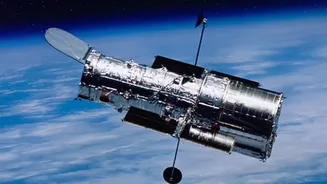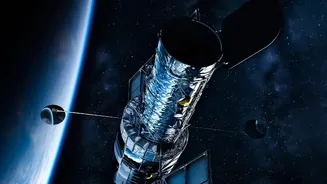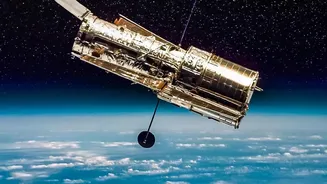








For over three decades, the Hubble Space Telescope has been humanity’s eye on the cosmos. But its legendary journey is threatened by a slow, relentless fall toward Earth. Now, NASA is making an unprecedented move to save it.
A Slow Descent from the Heavens
Like all satellites in low-Earth
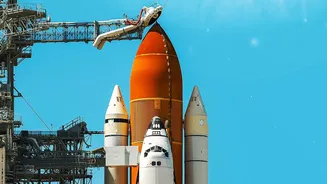
orbit, the Hubble Space Telescope is subject to atmospheric drag. Even in the thin air hundreds of kilometers up, tiny particles create friction, causing the observatory to gradually lose altitude. Since its last service mission in 2009, Hubble’s orbit has decayed, and without a push, it is projected to make an uncontrolled reentry into Earth's atmosphere sometime between 2033 and 2034. The telescope has no propulsion system of its own to counteract this orbital decay. In the past, Space Shuttle missions would physically visit Hubble, with astronauts performing repairs and using the shuttle's thrusters to boost it back to a higher, more stable orbit. With the shuttle fleet retired, NASA has been left without its traditional method for servicing this invaluable scientific asset.
NASA's New Playbook: A Commercial Lifeline
In a significant shift of strategy, NASA has issued a formal Request for Information (RFI), essentially asking the private space industry for ideas on how to save Hubble. The RFI, which opened in late October 2026, outlines three potential paths: a 're-boost' mission to push Hubble into a higher orbit, a servicing mission to upgrade its capabilities, or a controlled de-orbit to ensure it comes down safely. This isn't a formal contract but a market survey to gauge what's technically possible and, crucially, how much it might cost. NASA has made it clear that any proposed solution must be cost-effective and not harm the aging telescope. This move reflects the agency’s recognition of the rapidly growing capabilities of the commercial space sector, which now offers services once exclusive to government space programs.
Who Could Answer the Call?
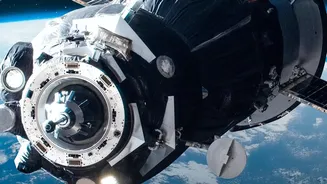
The most-discussed potential partner is SpaceX. Back in 2022, the company, in partnership with the private Polaris Program led by billionaire Jared Isaacman, proposed a study to examine the feasibility of using a Dragon spacecraft to rendezvous with and re-boost Hubble. While NASA and SpaceX conducted an unfunded study, the agency decided at the time not to move forward with that specific plan. However, the new RFI opens the door to a wider range of companies and concepts, including both crewed and robotic missions. Companies specializing in in-space servicing and robotics, such as Astroscale and Northrop Grumman, could also present robotic solutions that may be seen as lower-risk alternatives to a crewed mission. The company that takes on the mission would be responsible for providing the rocket, the spacecraft, and all mission operations.
More Than a Repair Mission
A successful commercial mission to Hubble would be about more than just preserving one telescope. It would serve as a powerful proof of concept for a new era of space logistics. The ability for private companies to affordably service, refuel, and reposition satellites could transform space operations, extending the lives of hugely expensive assets and creating a sustainable economy in orbit. A re-boost could add another 15 to 25 years to Hubble's operational life, allowing it to continue its groundbreaking scientific work well into the 2030s and even beyond. This is particularly important because Hubble observes the universe in visible and ultraviolet light, a capability that its successor, the James Webb Space Telescope, does not have, as it focuses on the infrared spectrum. Keeping Hubble online ensures astronomers have a multi-spectrum view of the cosmos.