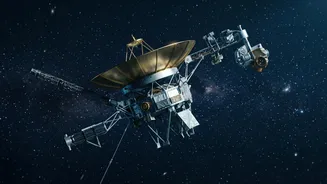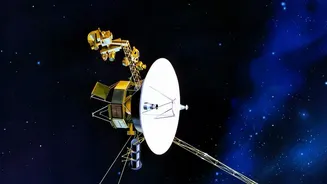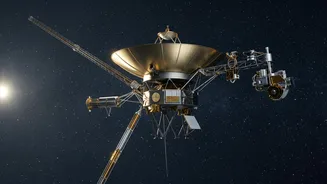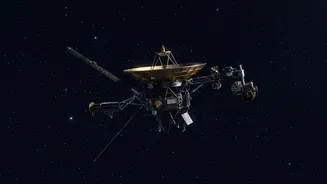

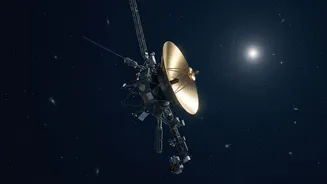
Launched when disco was king, a relic of 1970s technology is about to set a record that is almost impossible to comprehend. NASA's Voyager 1 is fast approaching a distance of one light-day from Earth, a testament to human ingenuity.
A Journey Measured in Light
On November 18, 2026,
after traveling for nearly 50 years, Voyager 1 will achieve a monumental first: it will be one light-day away from Earth. This isn't a measure of time, but of immense distance. A light-day is how far a particle of light travels in 24 hours, which comes out to approximately 25.9 billion kilometers, or about 16.1 billion miles. To put that into perspective, light from the Sun takes a little over eight minutes to reach Earth. A radio signal sent from NASA's Deep Space Network to Voyager 1 on that day will take a full 24 hours to arrive. Any response from the distant probe will take another 24 hours to travel back, making round-trip communication a two-day affair. It took the spacecraft 49 years, two months, and 11 days to cover a distance that light crosses in a single day.
From Grand Tour to Interstellar Explorer
Voyager 1's incredible longevity was never part of the original plan. Launched on September 5, 1977, its primary mission was to conduct flybys of Jupiter and Saturn. It was part of a 'Grand Tour' of the outer planets, taking advantage of a rare planetary alignment. During its encounters in 1979 and 1980, the probe made stunning discoveries, revealing active volcanoes on Jupiter's moon Io and the complex, intricate nature of Saturn's rings. After its flyby of Saturn's moon Titan in November 1980, its planetary mission was complete, and it was flung by the gas giant's gravity onto a new path heading out of the solar system. In August 2012, it officially entered interstellar space, becoming the first human-made object to cross the heliopause—the boundary where the Sun's influence gives way to the vast expanse between stars.
A Golden Record for the Cosmos
Should Voyager 1 ever be found by an intelligent extraterrestrial civilization, it carries a message: the Golden Record. This is a 12-inch gold-plated copper disk containing sounds and images selected to portray the diversity of life and culture on Earth. A committee chaired by the famed astronomer Carl Sagan assembled its contents, which include 115 images, a variety of natural sounds like wind and whale songs, musical selections from different cultures and eras, and greetings in 55 languages. The record also carries the brainwaves of Ann Druyan, a science communicator who was part of the project. Sagan described the record as a 'bottle' cast into the 'cosmic ocean', a hopeful testament from our planet.
Surviving the Void
Keeping a nearly 50nd year old spacecraft functioning from billions of kilometers away is a constant challenge. In October 2026, mission controllers briefly lost contact with Voyager $#$ for $#$ hours before the signal mysteriously returned. Engineers determined that an onboard fault protection system had automatically switched to a backup set of thrusters. This incident highlighted the fragility of the aging probe, which is powered by radioisotope thermoelectric generators that convert the heat from decaying plutonium into electricity. With its power supply losing about four watts per year, NASA engineers have become increasingly creative, recently performing a power saving maneuver nicknamed the 'Big Bang' to shut down nonessential heaters and extend the life of the remaining science instruments.
The Long Goodbye
The one light day milestone may be one of Voyager $#$ last major achievements while it can still communicate with its creators. As its power dwindles, NASA will be forced to shut down its few remaining science instruments one by one. By around $#$36$, its signal will likely become too faint for the Deep Space Network to detect, and the probe will fall silent forever. Yet its journey will continue. The spacecraft is currently speeding toward an obscure star in the constellation Ursa Minor, which it is expected to pass in about $#$ thousand years. Even after it can no longer phone home, Voyager $#$ will endure as a silent ambassador, a ghost of human curiosity drifting through the Milky Way for eons to come.