

The Old Way: A Manual Process
Not long ago, restoring a damaged photo was the painstaking work of a skilled digital artist using tools like Photoshop's Clone Stamp. This tool lets an editor copy pixels from a clean part of the image and 'paint' them over a damaged area like a scratch
or tear. While effective for small fixes, this method has major limitations. It is incredibly time-consuming, and for complex or non-repeating textures like crumpled paper, wood grain, or fabric, the cloned areas can look fake and repetitive. The quality of the repair depended entirely on the artist's skill, time, and patience.
The AI Shift: From Copying to Understanding
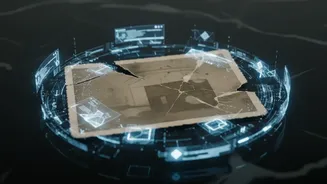
Modern AI plugins operate on a completely different principle. Instead of just copying pixels, they use a technology called 'inpainting' powered by generative AI. These AI models are trained on millions of pairs of damaged and pristine images. Through this training, they don't just learn to patch a hole; they learn what a photograph is supposed to look like. The AI develops an understanding of context, recognizing the difference between skin texture, a fabric pattern, and the fibrous grain of aged paper. This allows it to generate entirely new pixels that are a plausible, realistic fit for the damaged area.
Training an AI to 'See' Texture
The secret to AI's precision lies in its training with deep learning models, specifically Convolutional Neural Networks (CNNs). These networks are designed to recognize patterns and features at different layers of abstraction. When analyzing a photo, a CNN can identify not just the obvious damage but also the subtle statistical properties of the surrounding texture. For paper, this means recognizing the random-yet-uniform nature of its grain, how light reflects off a crease versus a flat surface, and how to replicate that authentically. The AI learns to synthesize new texture that matches the original's character, rather than just covering a flaw.
Generative Models: The Artists in the Machine
The most advanced plugins use sophisticated generative models, such as Generative Adversarial Networks (GANs) or, more recently, Diffusion Models. A GAN involves two competing AIs: a 'generator' that creates the restored patch and a 'discriminator' that judges whether it looks real. This competition pushes the generator to create increasingly convincing textures. Diffusion models work differently, by learning to reverse a process of adding digital 'noise' to an image. To fix a photo, the model treats the damage as noise and reconstructs the clean image it predicts was there before. This method is exceptionally good at creating high-fidelity, non-blurry results.
Handling Complex Damage With Context
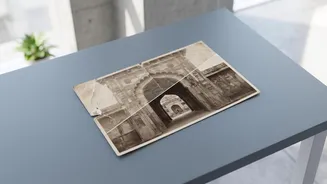
This contextual understanding is why AI excels at complex damage that would stump a manual editor. Consider a severe crease running across a person's face and onto the paper background. A traditional tool would require the editor to painstakingly rebuild the skin and then separately try to match the paper texture. An AI model analyzes the entire area at once. It recognizes the boundary between the face and the paper and generates pixels appropriate for each. It understands that the crease deforms the paper's texture and lighting in a specific way and reconstructs it accordingly, preserving the photo's original character without making it look like plastic.