



The Invisible Architecture of Space
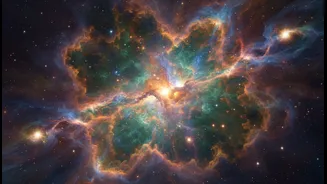
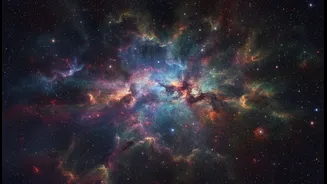
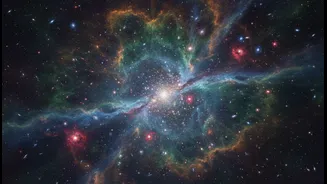
When you look at a vibrant Hubble image of a nebula, you're seeing a celestial nursery or the beautiful remnants of a dying star. These structures are overwhelmingly composed of interstellar gas—primarily hydrogen and helium—and dust. This is the raw
material from which stars, planets, and galaxies are made. However, in its natural state, much of this gas is either completely transparent or emits light in wavelengths our eyes cannot detect. If you were to fly through these regions in a spaceship, you wouldn't see the rich reds, blues, and greens that appear in a processed image. Instead, you might see a faint, uniform haze or nothing at all. The universe's most fundamental building blocks are hidden in plain sight, scattered across billions of light-years in clouds that are often cool, dark, and seemingly empty. Hubble's mission is to make this invisible architecture visible, transforming abstract clouds into tangible structures we can study.
Seeing with Invisible Light
Hubble's power lies in its ability to see beyond the narrow band of visible light that human eyes are sensitive to. Its instruments can detect light in both the ultraviolet (UV) and near-infrared (NIR) parts of the electromagnetic spectrum. This is crucial because different chemical elements, at different temperatures, glow brightly at these specific, invisible wavelengths. For example, hot, young stars may blast their surroundings with UV radiation, causing nearby hydrogen clouds to glow in a way Hubble can detect. Conversely, infrared light can penetrate dense clouds of dust that would otherwise obscure our view, revealing the newborn stars forming deep inside. To capture this information, Hubble doesn't take a simple color photo. Instead, it takes multiple monochrome (black and white) images, each time using a different filter to isolate a specific wavelength of light. Each of these black-and-white photos is a data map, showing the intensity of that particular type of light across the object.
Painting by Numbers, with Elements
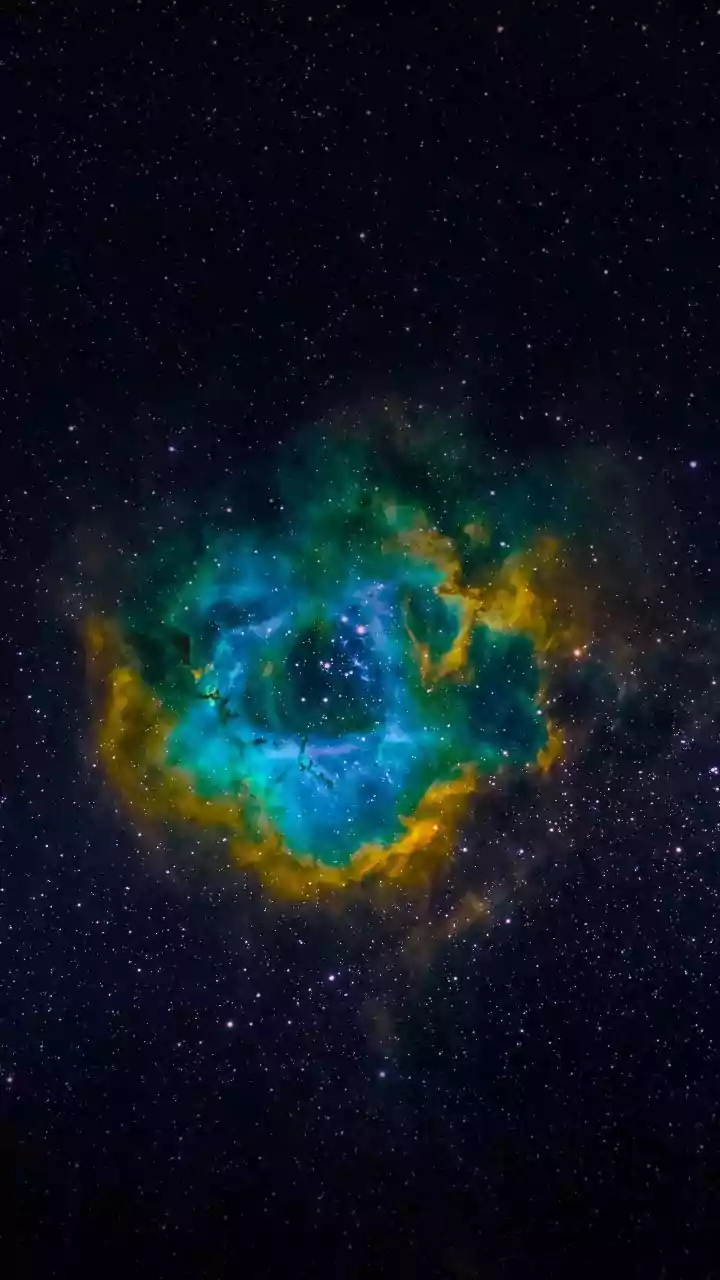
This is where the 'visual learning' truly begins. Scientists and image processors translate this wealth of data into the full-color images we recognize. The process is often called 'false-color' imaging, but it's not about making things up; it's about making the data understandable. Each black-and-white image taken with a specific filter is assigned a color, and then the images are combined. For example, in many famous Hubble images of nebulae, light emitted by sulfur atoms might be assigned the color red, hydrogen is assigned green, and oxygen is assigned blue. This specific mapping is known as the 'Hubble Palette'. By assigning colors to different elements, astronomers can instantly see the chemical composition of a nebula at a glance. A region that appears green is rich in hydrogen, while a blue area signifies abundant oxygen. This technique transforms a scientific dataset into a visually intuitive map of cosmic chemistry.
The Lessons in the Light
These colorized maps provide profound insights. In the iconic 'Pillars of Creation' within the Eagle Nebula, the images show how the towering columns of dense gas and dust are being eroded by the intense radiation from nearby massive stars. The colors reveal the interaction between the destructive stellar winds and the resilient, star-forming material. We can visually distinguish the glowing, ionized gas being stripped away from the denser, darker pillars where new stars are being born. Without this color-coding, the complex physics of the scene would be much harder to untangle. By studying the shapes, colors, and textures of these gas clouds, astronomers can read the history and future of a region. They can see where stars are actively forming, trace the shockwaves from supernova explosions, and watch as dying stars shed their outer layers to create intricate planetary nebulae. Each image tells a story about the life cycle of stars and the constant evolution of our galaxy.