


Our First Confirmed Visitor
In October 2017, humanity had its first confirmed encounter of the interstellar kind. Astronomers using the Pan-STARRS telescope in Hawaii spotted a faint point of light moving so fast that our sun’s gravity couldn’t hold onto it. This was not a member
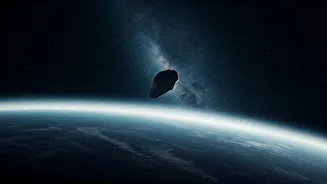
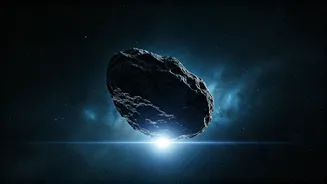
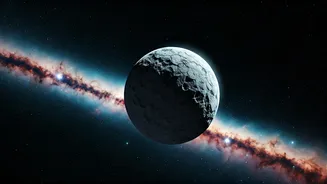
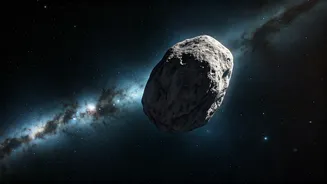
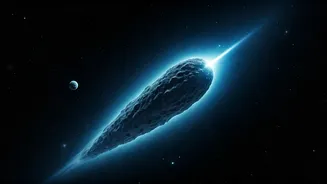
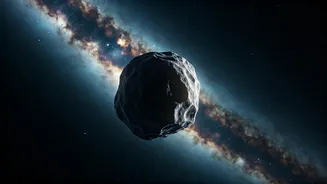
of our solar system; it was a tourist just passing through. Named 1I/ʻOumuamua, a Hawaiian word meaning “a messenger from afar arriving first,” the object immediately baffled scientists. Its brightness varied dramatically, suggesting it had a highly unusual shape—perhaps like a cigar or a flat pancake, ten times longer than it was wide. Unlike comets from our own solar system, it showed no visible tail of gas or dust as it zipped past the sun, even though it displayed a slight acceleration that couldn't be explained by gravity alone. This combination of strange characteristics—a bizarre shape, no visible coma, and unexpected acceleration—made ʻOumuamua one of the most puzzling astronomical discoveries of the decade.
The Second Messenger Arrives
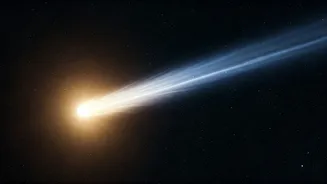
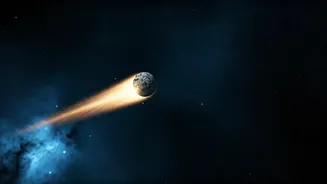
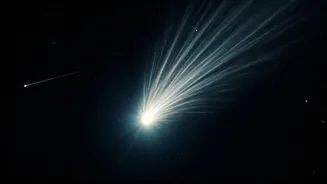
Just as astronomers were busy debating the nature of ʻOumuamua, a second visitor arrived. In August 2019, amateur astronomer Gennadiy Borisov spotted a new object with a distinctly interstellar trajectory. Designated 2I/Borisov, this interloper was fundamentally different from its predecessor. Unlike the inert, rocky appearance of ʻOumuamua, 2I/Borisov looked and acted like a classic comet. It had a visible cloud of dust and gas (a coma) and a tail, confirming that icy bodies are indeed ejected from other star systems. However, it had its own peculiarities, including a much higher concentration of carbon monoxide than any comet from our solar system. The discovery of a second, completely different visitor confirmed that ʻOumuamua was not a fluke and that our solar system is routinely crossed by objects from other stars.
Cosmic Messengers in a Bottle
The scientific excitement around interstellar objects is immense because they are, in essence, messages in a bottle. They are pristine samples of the building blocks of planets from other star systems. By studying their composition, scientists can learn about the chemistry and conditions of worlds that are light-years away—a task that is impossible with telescopes alone. For example, 2I/Borisov’s high carbon monoxide levels suggest it may have formed in a very cold region of its home system, around a different type of star than our sun. ʻOumuamua’s rocky nature, meanwhile, hints at the existence of planetary systems with different evolutionary paths than our own. Each new visitor provides a data point in our quest to understand whether our solar system is typical or an outlier in the grand cosmic scheme.
A New Era of Discovery
Detecting these faint, fast-moving objects is incredibly difficult. We only found ʻOumuamua and Borisov through a combination of skill and luck, as our telescopes happened to be pointing in the right direction at the right time. But that is changing. The Vera C. Rubin Observatory in Chile, which began its 10-year survey of the sky in 2026, is set to revolutionize the field. With its enormous camera and ability to scan the entire visible sky every few nights, Rubin is expected to find dozens of interstellar objects, turning a trickle of discoveries into a flood. This will allow astronomers to move from studying individual oddities to analyzing a whole population of interstellar visitors. We will be able to build a statistical understanding of their origins, compositions, and the frequency with which they visit.