




A New Eye on the Cosmos
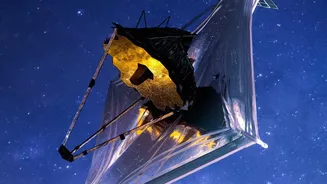
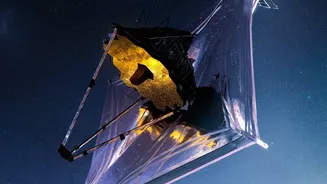
Named after Nancy Grace Roman, NASA’s first chief of astronomy, the telescope is a marvel of modern engineering. It features a primary mirror that is 2.4 metres in diameter, the same size as the Hubble Space Telescope's, but its key advantage lies in its Wide
Field Instrument (WFI). This powerful 300-megapixel infrared camera gives Roman a field of view 100 to 200 times larger than Hubble's infrared camera, allowing it to map vast swathes of the sky with incredible speed and detail. Think of it as the panoramic lens to Hubble and Webb's zoom lenses. While they focus on specific targets, Roman will create a grand atlas of the universe, identifying new points of interest for other telescopes to investigate. Now on a million-mile journey to its operational orbit, Roman is expected to begin its science mission in early 2027.
Hunting for Thousands of Hidden Worlds
One of Roman's primary goals is to complete a census of exoplanets in our galaxy, and it will use a fascinating technique to do it: gravitational microlensing. This method, predicted by Einstein's theory of general relativity, occurs when a foreground star and its planets pass in front of a more distant star. The gravity of the foreground system acts like a magnifying glass, briefly amplifying the background star's light. The presence of planets creates a distinct secondary flicker in this light, allowing astronomers to detect them and even measure their mass. This technique is sensitive enough to find planets as small as Mars and even free-floating 'rogue' planets that wander through space without a host star. In addition to discovering potentially thousands of new worlds through microlensing and transit methods, Roman will also use its advanced Coronagraph Instrument to directly image large planets around nearby stars, blocking the starlight to make the faint planets visible.
Illuminating the Dark Universe
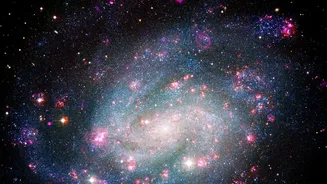
Roughly 95% of the universe is composed of mysterious substances we can't directly see: dark matter and dark energy. Roman is designed to attack these twin mysteries head-on. Dark matter provides the unseen gravitational scaffolding that holds galaxies together, while dark energy is the enigmatic force causing the expansion of the universe to accelerate. Roman will map the distribution of dark matter across cosmic history by studying how its gravity subtly distorts the light from billions of distant galaxies, a phenomenon known as weak gravitational lensing. To probe dark energy, the telescope will measure the precise distances to thousands of exploding stars (supernovae) and map the clustering of galaxies over time. By creating these vast 3D maps of the cosmos, scientists hope to understand whether dark energy's influence has changed over time, providing crucial clues to its true nature.
A Treasure Trove for All Astronomers
While the hunt for exoplanets and the study of dark energy are its core objectives, Roman’s capabilities extend much further. Its rapid surveying speed and wide field of view will create an unprecedented dataset, estimated to be over 20 petabytes during its primary mission. This wealth of information will be a public resource, enabling countless new discoveries. A significant portion of Roman's observing time, at least 25%, is designated for a guest investigator program, allowing scientists from around the world to propose their own studies. These could range from mapping asteroids in our own solar system to studying stellar nurseries and the supermassive black holes at the hearts of distant galaxies. The telescope's agility also allows it to quickly turn its attention to transient events like supernovae, providing crucial data on these fleeting cosmic occurrences.