



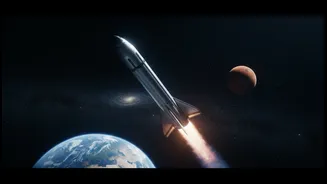
The Invisible Danger of Deep Space
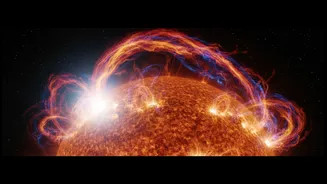
Space is not empty; it is filled with a constant shower of high-energy particles. Outside the protective bubble of Earth’s magnetic field, astronauts are exposed to two main types of radiation: galactic cosmic rays (GCRs) from distant supernovae and unpredictable
bursts from our own sun, known as solar particle events (SPEs). This isn't like getting an x-ray at the doctor's office. This radiation can penetrate spacecraft and the human body, potentially damaging DNA and increasing the long-term risk of cancer, cardiovascular disease, and central nervous system disorders. For missions confined to Low Earth Orbit, like those on the International Space Station, the planet’s magnetic field still offers some protection. But for future astronauts travelling to the Moon or Mars, this exposure will be significantly higher, making it one of the biggest hurdles to long-duration spaceflight.
A Flawed System of Limits
For years, NASA managed this risk with a complex set of career exposure limits. The standard aimed to ensure that no astronaut’s career exposure resulted in more than a 3% increase in their lifetime risk of dying from cancer. However, because risk models showed that women and younger astronauts were statistically more susceptible to radiation's effects, the allowable dose varied based on age and sex. This created a significant ethical and operational problem: it meant a young female astronaut would reach her career radiation limit far sooner than an older male colleague, effectively limiting her opportunities for long-duration missions. As NASA plans for a more diverse astronaut corps and more ambitious missions, this unequal standard became untenable.
A New, Universal Standard
Following recommendations from the National Academies of Sciences, Engineering, and Medicine, NASA has moved toward a single, universal career limit for all its astronauts: 600 millisieverts (mSv). This new standard does away with the age- and sex-based distinctions. To ensure it is protective for everyone, the limit was calculated based on the risk model for the most susceptible group: a 35-year-old female. In essence, NASA took the highest standard of protection it had and applied it across the board. This change not only promotes equality of opportunity but also simplifies the complex process of planning missions and astronaut careers. While other agencies like the European Space Agency have a higher limit of 1,000 mSv, NASA's approach is designed to be cautious while balancing operational needs.
Making Uncertainty Visible
Perhaps the most significant change is not the number itself, but the philosophy behind it. The headline's promise of making uncertainty visible refers to a new emphasis on transparent risk communication. Instead of just presenting a hard limit, the new approach involves giving astronauts a more complete and individualised picture of their risk. This includes explaining the uncertainties inherent in the scientific models. A risk is never a single, concrete number; it's a probability with a range of possibilities. By communicating that a projected 3% risk might have confidence intervals that stretch higher or lower, NASA is treating astronauts as active partners in their own health management. It’s a shift from simply telling them what is 'safe' to helping them understand the full, complex nature of the risks they are accepting.
The Martian Challenge
This new framework will be tested as NASA's ambitions grow. A round-trip mission to Mars could last up to three years, exposing the crew to radiation levels that could exceed 1,000 mSv—well above the new 600 mSv career limit. This means that for the first historic journeys to the Red Planet, NASA may need to consider waiving its own standard. In such a scenario, the policy of making uncertainty visible becomes even more critical. Astronauts undertaking such a mission will need to make a deeply personal decision, armed with the best and most honest information available about the profound, lifelong health risks they are facing for the sake of exploration. The conversation is no longer just about limits, but about informed consent at the very edge of human capability.