






The Tireless robotic scientists
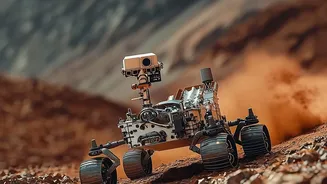
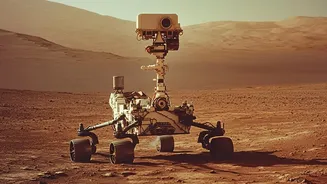
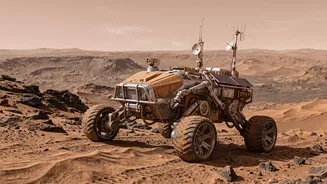
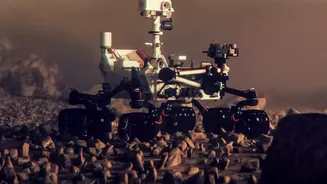
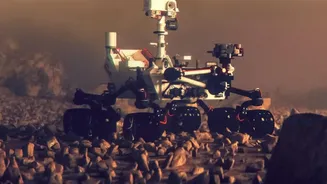
For years, Mars has been the exclusive domain of robots. Six-wheeled, car-sized laboratories like NASA's Curiosity and Perseverance rovers are our eyes, hands, and chemical sensors on another world. Curiosity, which landed in 2012, has long outlived its
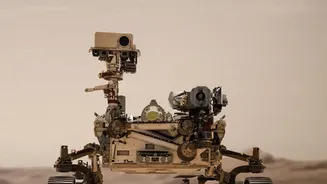
initial two-year mission, confirming that its landing site, Gale Crater, once held a lake that could have supported life. It continues to analyse rock layers, tracking how Mars transitioned from a potentially habitable world to a cold desert. More recently, the Perseverance rover, which arrived in 2021, is actively searching for signs of ancient microbial life in Jezero Crater. It has discovered a complex history of water interacting with rocks and has found a diverse collection of organic molecules, the chemical building blocks of life. These are not just sightseeing trips; these are complex scientific missions delivering a stream of data that is crucial for planning future exploration.
The Strong Case for Machines
The argument for leading with robots is overwhelmingly practical. First, there's the cost. A robotic mission like Perseverance costs under $3 billion. Estimates for a crewed mission to Mars, however, can soar into the hundreds of billions. This staggering difference is due to the requirements of keeping humans alive. Astronauts need years' worth of food, water, and breathable air, all of which add immense weight and complexity to a spacecraft. Second, there is the immense risk. Deep space is hostile, bombarding travellers with cosmic radiation that poses significant health threats, including an increased risk of cancer. Mars itself lacks a global magnetic field and has a thin atmosphere, offering little protection. Robots are immune to these dangers. They can operate for years in harsh conditions, endure extreme temperatures, and don't need a return ticket, allowing them to function until their power sources finally give out.
The Irreplaceable Human Element
Despite the advantages of rovers, there are things a human can do that a robot simply cannot. The primary advantage is speed and adaptability. A rover like Curiosity moves at a top speed of about 0.14 km/h, and every action must be meticulously planned and transmitted from Earth, contending with a communication delay of up to 40 minutes. An astronaut, by contrast, can make decisions in real-time. They can walk over terrain that would trap a rover, pick up an interesting rock on a hunch, and perform complex experiments far more quickly. Proponents of human missions argue that to truly search for elusive signs of fossilised life, it will take geologists on the ground, cracking open countless rocks—a task too slow and cumbersome for a remote-controlled robot. The Apollo 17 astronauts covered more ground on the Moon in three days than the Curiosity rover has in over a decade, showcasing the incredible efficiency of human explorers.
A Partnership, Not a Competition
Ultimately, framing the debate as 'robots versus humans' misses the point. The most effective strategy for Mars exploration involves a partnership where one paves the way for the other. Every robotic mission to date has been a crucial precursor for an eventual human landing. Orbiters map the surface to find safe landing sites, and rovers analyse the climate and radiation environment. Perseverance is actively testing technologies vital for human survival. Its MOXIE instrument has successfully demonstrated that it's possible to produce oxygen from the thin Martian atmosphere—oxygen that could one day be used for breathing and for rocket propellant. The rover is also collecting rock core samples, caching them for a future, complex robotic mission that will return them to Earth for in-depth study in advanced laboratories, something impossible to do on Mars itself. These robotic pioneers are not replacing human astronauts; they are doing the essential reconnaissance to ensure that when humans do finally set foot on Mars, their mission is as safe and scientifically productive as possible.