



The Sun's Destructive Power
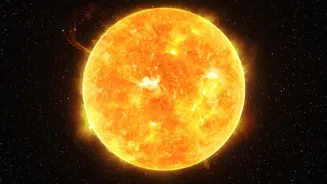
The Sun may seem stable, but it's a dynamic star that regularly unleashes tremendous energy. While the term 'solar flare' is well-known, the primary threat to our technology often comes from something called a Coronal Mass Ejection (CME). Flares are intense
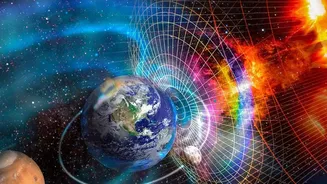
bursts of radiation, but CMEs are colossal clouds of solar plasma and magnetic fields hurled into space. If a CME is aimed at Earth, it can take one to three days to arrive, but the impact can be devastating. When this magnetized plasma slams into Earth's magnetic field, it can trigger a geomagnetic storm, inducing powerful electrical currents in long conductors like power lines and undersea internet cables, potentially causing widespread blackouts and communication failures.
The Challenge of Staring at the Sun
Detecting these threats before they leave the Sun is tricky. The problem is that the Sun's outer atmosphere, the corona, is where CMEs are born. This region is about a million times fainter than the Sun's bright surface, or photosphere. Trying to see the faint corona is like trying to spot a candle flame next to a powerful searchlight. The overwhelming glare of the Sun's disk completely washes it out. To provide an early warning, scientists needed to find a way to block the Sun's intense light without blocking the view of the crucial area right beside it.
Creating an Artificial Eclipse in Space
The solution is a brilliantly clever instrument called a coronagraph. First developed in the 1930s for ground-based telescopes, the concept is now perfected in space. A space-based coronagraph uses a precisely positioned solid disk, called an occulter, to block the direct light from the Sun's surface. This creates a perpetual, artificial solar eclipse, allowing the satellite's sensitive cameras to capture clear images of the much fainter corona. By continuously monitoring this region, scientists can see a CME as it erupts and billows outwards, long before it reaches our planet.
India's Vigilant Eye: The Aditya-L1 Mission
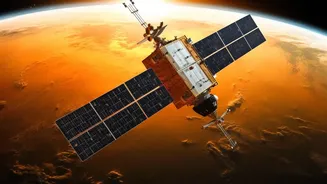
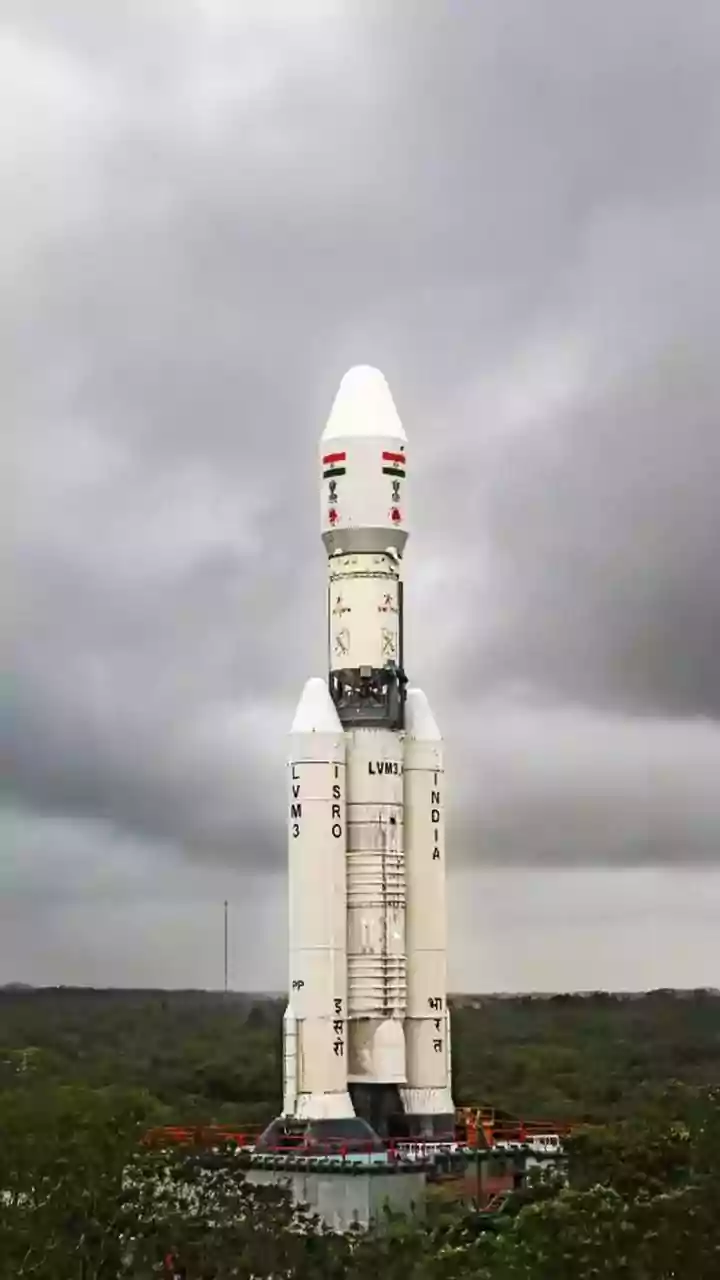
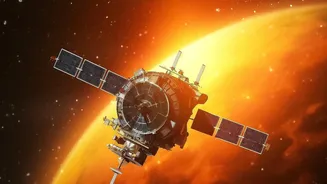
India has firmly established its presence in this critical field with the Aditya-L1 mission. Positioned at the strategic Lagrange point 1 (L1), about 1.5 million km from Earth, the spacecraft has an uninterrupted view of the Sun. Its primary payload is the Visible Emission Line Coronagraph (VELC), an advanced instrument designed to study the solar corona in great detail. VELC observes the corona closer to the Sun's disk than many previous instruments, providing crucial data on the origin and early acceleration of CMEs. Along with its other six payloads, Aditya-L1 gives Indian scientists a comprehensive toolkit to monitor solar activity and contribute to global space weather prediction.
From Detection to Action
Spotting a CME is only the first step. Once a coronagraph satellite like Aditya-L1 or NOAA's GOES-19 detects an Earth-directed eruption, the data is sent to space weather forecasters. They analyze the images to determine the CME's size, speed, and direction. This information allows them to issue warnings one to three days before impact. This lead time is crucial. It allows satellite operators to put sensitive spacecraft into a safe mode, power grid managers to protect their systems from induced currents, and airlines to reroute flights away from polar regions where radiation exposure is higher. Newer operational coronagraphs can now deliver imagery within 30 minutes, a vast improvement over the hours it took with older research satellites.