

A Celestial Downpour
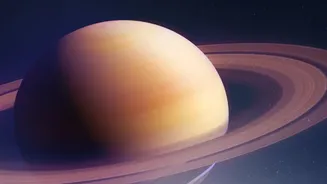
For decades, scientists have theorized about a phenomenon known as 'ring rain' at Saturn. The idea was that particles from the planet's magnificent rings were not just orbiting in space, but actively falling into the planet itself. Thanks to data from NASA's
Cassini mission, especially during its final, daring orbits in 2017, this theory is now a well-documented reality. Researchers found that the flow of material is far more intense than ever imagined, describing it less as a gentle rain and more as a 'downpour.' This process involves tiny particles, drawn from the rings by Saturn's gravity and powerful magnetic field, which then spiral down into the upper atmosphere. The sheer volume is staggering, with estimates suggesting that between 4,800 and 45,000 kilograms of material fall onto the planet every second.
Clues from Cassini's Grand Finale
The key evidence came from the Cassini spacecraft's 'Grand Finale.' As the probe was running low on fuel after 13 years of exploring the Saturnian system, mission controllers sent it on a series of 22 orbits through the previously unexplored gap between the planet and its innermost rings. During these high-speed passes, instruments like the Ion and Neutral Mass Spectrometer (INMS) directly sampled the particles falling into the planet. These particles hit the spacecraft at such high velocities that they vaporized, allowing the instrument to analyze their chemical composition. This was a monumental achievement, providing the first-ever direct measurements of the material journeying from the rings to the planet and confirming a dynamic interaction that is reshaping Saturn in real time.
A Surprising Chemical Cocktail
One of the biggest surprises was the composition of this ring rain. While Saturn's rings are known to be composed almost entirely of water ice, the material raining down was a much more complex mixture. Water constituted only about 24 percent of the influx. The rest was a surprising cocktail of molecules, including methane, carbon monoxide, ammonia, carbon dioxide, and fragments of complex organic compounds like butane and propane. This discovery was unexpected and suggests that the processes governing the ring rain are more complicated than previously thought. Scientists are now exploring why the rain is so chemically diverse compared to the rings' overall composition, a puzzle that could reveal new details about the dynamics between the rings and the planet’s magnetic field.
Impact on Saturn and Its Rings
This constant downpour has significant consequences for both Saturn and its rings. The influx of material alters the chemistry and temperature of Saturn's upper atmosphere. The rain effectively 'quenches' parts of Saturn's ionosphere, reducing the density of charged particles in the regions where it falls. This explains long-standing observations of unusually low electron densities at certain latitudes. Furthermore, this mass loss means the rings themselves have a finite lifespan. Based on the measured rate of ring rain, scientists estimate that the iconic ring system could be entirely gone within 100 to 300 million years. While that sounds like a long time, it is a relatively brief period in cosmic terms, suggesting we are lucky to be living in an era when Saturn is so beautifully adorned.