



An Inflatable Shield for a Fiery Plunge
When a spacecraft plummets through an atmosphere, whether Earth's or Mars', it travels at hypersonic speeds, converting immense kinetic energy into blistering heat. For decades, engineers have relied on rigid, heavy heat shields to protect these valuable
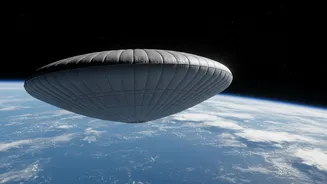
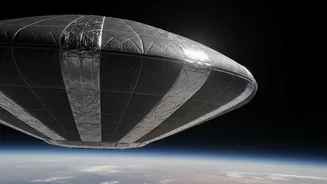
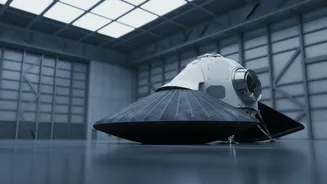
assets. Now, a new concept is taking shape: the Hypersonic Inflatable Aerodynamic Decelerator, or HIAD. This technology involves a heat shield that launches in a tightly packed configuration and inflates to a large diameter just before entering the atmosphere. NASA, in partnership with companies like United Launch Alliance (ULA), has been developing this technology for over a decade, culminating in successful tests like the Low-Earth Orbit Flight Test of an Inflatable Decelerator (LOFTID).
Bigger Brakes for a Softer Landing
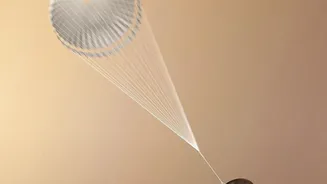
The primary advantage of an inflatable heat shield is its size. Traditional rigid heat shields are limited by the dimensions of the rocket fairing they launch in. An inflatable aeroshell, however, can be deployed to a diameter much larger than its launch container. This larger surface area creates significantly more drag, acting like a giant brake. This is especially crucial for destinations like Mars, where the atmosphere is incredibly thin. A larger decelerator can begin slowing the spacecraft at a much higher altitude, where the air is less dense, leading to a gentler descent and less intense heating. This capability is essential for landing the heavy payloads, such as habitats and large rovers, required for future human missions.
Materials That Can Take the Heat
The engineering challenge is immense: how do you make a flexible, inflatable structure that can withstand temperatures hot enough to melt steel? The solution lies in a multi-layered system of advanced materials. The outer layer is often a fabric woven from ceramic fibers, like silicon carbide, which can tolerate extreme temperatures. Beneath this is a stack of flexible insulation blankets that prevent the heat from reaching the inflatable structure itself. The inflatable part consists of a series of rings, or tori, made from high-strength braided materials such as Kevlar, which are tough and can maintain their shape under immense pressure and aerodynamic forces.
Proven in a Successful Test Flight
The LOFTID mission in November 2022 was a landmark demonstration of this technology. Launched as a secondary payload, the 6-meter diameter inflatable aeroshell successfully re-entered Earth's atmosphere at nearly 18,000 miles per hour. The vehicle withstood the extreme forces and temperatures, decelerated stably, and splashed down safely in the Pacific Ocean, where it was recovered in excellent condition. The test flight confirmed that the structural and thermal models were accurate and proved the viability of using HIADs for high-energy orbital re-entry, paving the way for more ambitious applications. The success of LOFTID has sparked widespread interest, with some companies now exploring designs up to 20 meters across.
Unlocking the Solar System
Inflatable heat shield technology is a game-changer for space exploration. For Mars, it means being able to land heavier cargo at higher, scientifically interesting elevations that are currently inaccessible. This is a critical step for establishing a human presence on the Red Planet. The technology also has significant applications closer to home. It could enable the recovery of launch vehicle assets, like ULA's Vulcan rocket engines, significantly reducing the cost of access to space. Furthermore, it provides a way to return large items and in-space manufactured goods from low-Earth orbit and the International Space Station. By solving one of the biggest challenges of atmospheric entry, inflatable heat shields are opening the door to a new era of exploration on Earth, Mars, Venus, and beyond.