




What Did Webb Actually Find?
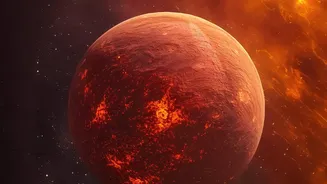
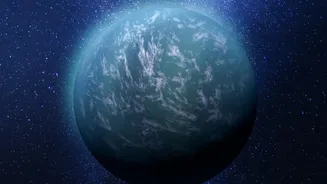
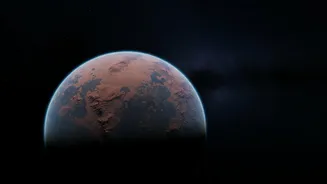
Scientists using the James Webb Space Telescope (JWST) have confirmed the presence of carbon dioxide (CO2) in the atmosphere of TRAPPIST-1e, a rocky, Earth-sized planet. More interestingly, the CO2 appears to be enriched with a 'heavy' form of carbon,
known as Carbon-13. On Earth, the vast majority of carbon is the lighter Carbon-12. A different ratio of these isotopes on another world is a significant finding because various geological and biological processes can alter this ratio. While the detection of CO2 itself was anticipated as a possibility, the specific isotopic signature is a puzzle that astrobiologists are now working to solve. The finding doesn't point to one single conclusion but opens up several fascinating possibilities about the planet's history and composition.
Why Is the TRAPPIST-1 System So Important?
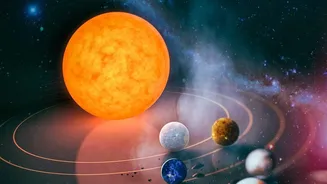
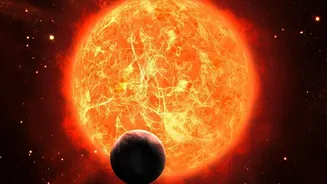
The TRAPPIST-1 system is one of the most remarkable discoveries in modern astronomy. Located just 40 light-years away, it consists of seven rocky, Earth-sized planets orbiting a small, cool star called an ultracool red dwarf. At least three of these planets, including TRAPPIST-1e, orbit within the star's 'habitable zone'—the region where temperatures could be just right for liquid water to exist on the surface. Its compact nature allows scientists to study multiple planets in the same system, offering a unique laboratory for comparing different worlds that formed around the same star. Because the star is small, the transiting planets block a larger, more easily detectable portion of its light, making it a perfect target for JWST to study their atmospheres.
How Webb Sniffs Out Alien Atmospheres
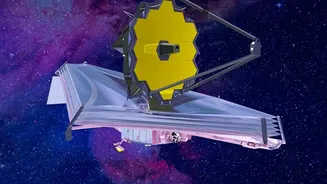
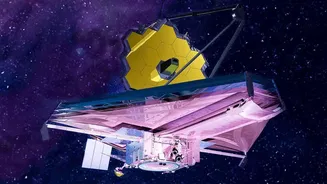
The JWST doesn't take direct pictures of the planet's surface. Instead, it uses a technique called transmission spectroscopy. When a planet like TRAPPIST-1e passes, or transits, in front of its star, a tiny fraction of the starlight filters through the planet's atmosphere. Different gas molecules in the atmosphere absorb specific wavelengths, or colours, of this light. By analysing the starlight that reaches the telescope, scientists can see which colours are missing and deduce which gases are present, creating a chemical fingerprint of the alien sky. It was through this meticulous process that the signature of heavy carbon dioxide was identified, showcasing the incredible precision of the telescope's instruments.
A Sign of Life? Not So Fast
This is the billion-dollar question, and the answer is a firm 'maybe, but probably not yet'. Carbon is the backbone of life as we know it, so finding it in any form is exciting. Certain biological processes on Earth, like photosynthesis, can favour one carbon isotope over another, altering the atmospheric ratio. However, there are many non-biological ways to get a similar result. Intense volcanic activity, for example, can release gases from a planet's mantle that might have a different isotopic signature. The interaction of the atmosphere with the star's radiation could also play a role. Scientists are clear: this detection is a tantalising clue, not proof of life. It’s a single data point in a vast puzzle, and for now, it raises more questions than it answers.
What Happens Next in the Search?
This discovery is not an endpoint; it is the starting gun for a new phase of investigation. Astrobiologists and astronomers will now use this initial data to build more complex models of TRAPPIST-1e's environment. The next critical step is to point the JWST back at the planet for more observations. Scientists will be looking for what they call a 'biosignature cocktail'—a combination of gases that is hard to explain without biology. For example, finding this specific CO2 signature alongside gases like methane and oxygen would be a much stronger, though still not definitive, sign. Researchers will also study the other TRAPPIST-1 planets to see if this carbon signature is unique to planet 'e' or a common feature of the system, which would provide more context about its origin.