







The Great Greening of India
Over the last two decades, India has seen a remarkable increase in its green cover. Studies, including those from NASA, show that the nation is responsible for a significant portion of the planet's increased foliage, an area equivalent to the Amazon rainforests.
This greening is largely driven by human activity, specifically intensive agriculture and ambitious afforestation programs. A recent study led by the Indian Institute of Tropical Meteorology (IITM) projects this trend will continue, with plant growth potentially doubling by 2100 under some climate scenarios. On the surface, more trees and crops sound like an unqualified victory for a populous country, suggesting more food and a larger carbon sink. But the story of India's greening is a classic case of appearances being deceptive.
A Thirsty Green Blanket
One of the most significant risks lurking beneath this verdant canopy is severe water stress. A large portion of India's greening, particularly 82% of it, comes not from natural forests but from intensive agriculture. This form of agriculture, especially the cultivation of water-hungry crops like rice and wheat, is heavily dependent on irrigation. India is already the world's largest user of groundwater, and this intensive farming is causing aquifers to be depleted at an alarming rate. In states like Punjab, the heartland of the Green Revolution, water tables are dropping precipitously, forcing farmers to drill deeper and deeper wells, which in turn can bring up water contaminated with harmful minerals like arsenic and uranium. So while the landscape looks green, it's being sustained by draining a finite and critical natural resource, a situation described as a trap.
The Problem with Monocultures
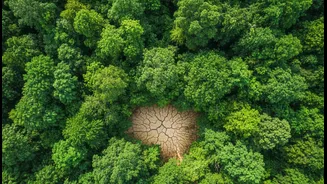
Not all green is good green. Much of India's afforestation and agricultural expansion relies on monocultures—growing a single species of plant over a vast area. This is true for both crops like wheat and for tree plantations using fast-growing species like eucalyptus. While this approach is efficient and yields quick results visible from space, it has devastating ecological consequences. Monoculture plantations create 'green deserts' that are terrible for biodiversity, as they cannot support the complex web of insects, birds, and other animals that thrive in natural, diverse forests. They also degrade the soil by repeatedly drawing the same nutrients, leading to a greater dependency on chemical fertilisers. Furthermore, these uniform landscapes are highly vulnerable to pests and diseases, which can spread rapidly without the natural barriers found in a diverse ecosystem.
The Carbon Paradox
Another driver of greening is the 'CO2 fertilisation effect', where higher levels of atmospheric carbon dioxide stimulate plant photosynthesis. A recent IITM study confirms this is a major factor in India's projected greening. However, this doesn't mean climate change is good for India's ecosystems. Researchers caution that more plant growth does not automatically translate into more carbon being stored long-term, as heat stress can cause plants and soil to release carbon back into the atmosphere. Some studies even show that while vegetation cover is increasing, the ability of these forests to efficiently absorb carbon is weakening, especially in ecologically sensitive areas like the Western Ghats. The increased CO2 can also reduce the nutritional quality of crops, a serious concern for food security.