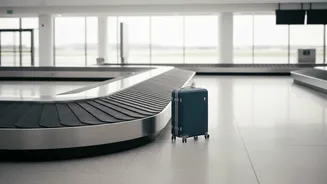








A Landmark Ruling for Travellers
In a significant decision dated July 2026, a district consumer commission in Kerala ordered an airline to pay a passenger a total of ₹53,923 for a three-day delay in delivering his luggage. The case involved a passenger travelling from Jammu to Coimbatore
in December 2025 whose checked bag did not arrive with him. Forced to buy essential clothing, he immediately filed a Property Irregularity Report (PIR) at the airport—a crucial first step. Despite his repeated follow-ups and a formal complaint on the government's INGRAM portal, the airline failed to provide the mandatory compensation outlined in the Ministry of Civil Aviation's Passenger Charter. The commission found this failure to be a “deficiency in service,” a key determination that went beyond the simple fact of the delay itself.
Why This Changes the Game
The Kerala ruling is a game-changer because the compensation awarded was not limited to the standard liability cap for delayed baggage, which is typically ₹20,000 for domestic flights under DGCA rules. The commission awarded the passenger reimbursement for his essential purchases (₹8,923), the standard ₹20,000 for the delay, and an additional ₹15,000 for the airline's “deficiency in service,” plus ₹10,000 for litigation costs. This sends a powerful message to airlines: simply ignoring a passenger's rights and complaints can have financial consequences that exceed the base compensation amounts. It affirms that passengers are not only entitled to compensation for the direct costs of a delay but also for the poor service and inconvenience suffered when an airline fails to follow its own mandated procedures. For travellers, this means that diligently documenting every step of the process is more valuable than ever.
The Most Important Form at the Airport
The single most critical document in any baggage claim is the Property Irregularity Report (PIR). Without it, a claim is almost impossible to process. This report must be filed at the airline’s baggage service counter inside the arrival hall before you exit. Once you leave the baggage claim area, it becomes incredibly difficult to prove the airline was responsible. The PIR is the official record that your bag was delayed, damaged, or lost, and it generates a reference number that becomes the foundation of your entire claim. When you file it, have your boarding pass and baggage tag—the little sticker usually placed on the back of your pass—ready, as they contain the tracking information for your luggage.
Your New Pre-Trip Checklist
The recent ruling underscores that preparation is everything. Before you even zip up your suitcase, adopting these habits can make all the difference between a frustrating loss and a successful claim.
Photograph Your Contents and Bag
Before you leave home, take a few quick photos of the valuable items you are packing in your checked luggage. If your bag is officially declared lost (usually after 21 days), you will need to provide an inventory of its contents. Having photographic proof of that expensive jacket or new pair of shoes makes your claim for their value much stronger. Additionally, take a picture of your closed suitcase. This serves as proof of its condition before you handed it over to the airline, which is essential if you need to file a claim for damage.
Keep Receipts for Valuables
For any high-value items in your checked luggage—electronics, designer clothes, specialised equipment—keep a digital and/or physical copy of the purchase receipt. If your bag is lost, the airline's compensation is meant to cover the value of your lost items. Without proof of purchase, you may only be offered a standard, often much lower, amount. Receipts are the clearest evidence of an item’s worth and are instrumental in getting the compensation you are rightfully owed. This also applies to any essential items like toiletries and clothing you are forced to buy while your bag is delayed; keep every single receipt to claim reimbursement.
Guard Your Documents
Your travel documents are your evidence. Never throw away your boarding pass after landing, and always keep the baggage claim tags/stickers until you have your luggage safely in hand. These small pieces of paper are critical for filing the PIR and for any subsequent communication with the airline. It is also wise to take a photo of your baggage tag sticker as a backup as soon as it is attached to your boarding pass at the check-in counter.