



A Day Longer Than a Year
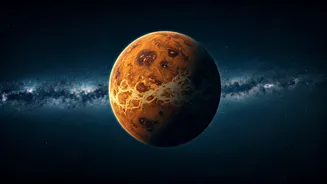
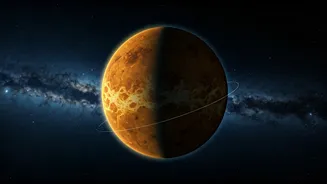
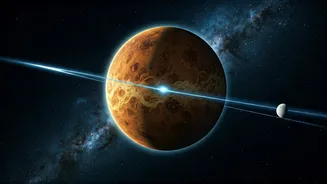
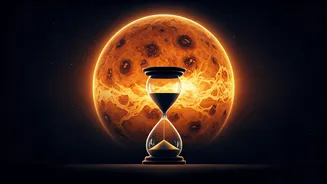
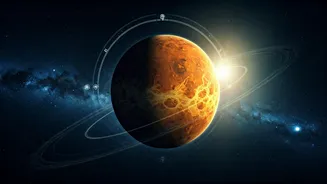
Let’s just get right to it. On Venus, a single day is longer than an entire year. Take a moment to let that sink in. A year, the time it takes for a planet to complete one full orbit around the Sun, is a fundamental measure of time. A day, the time it takes for a planet to rotate
once on its own axis, is another. On Earth, we have 365 days in our year. On Mars, it’s about 668. But on Venus, the numbers are completely scrambled. It takes Venus about 225 Earth days to travel around the Sun once. That’s its year. However, it takes a staggering 243 Earth days for Venus to spin just once on its axis. This means that if you were standing on Venus, you would celebrate your first birthday before you even experienced a full day-night cycle. It's a concept so alien that it sounds like something out of science fiction, but it's the bizarre reality of our neighbouring planet.
But Wait, It Gets Weirder
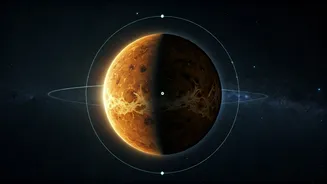
The long day is just the beginning of Venus's strangeness. Not only does it spin incredibly slowly, but it also spins backward. Nearly every planet in our solar system, including Earth, rotates on its axis from west to east. This is why we see the Sun rise in the east and set in the west. This shared direction of spin, known as prograde rotation, is believed to be a leftover from the formation of the solar system, when the swirling disc of gas and dust that formed the planets all moved in the same general direction. But Venus breaks the rules. It has what’s called a retrograde rotation, spinning from east to west. So, on the off chance you could survive its crushing atmosphere and scorching surface temperatures, you would watch the Sun make its excruciatingly slow journey across the sky by rising in the west and setting in the east. Only Uranus, which is knocked over on its side, shares a similarly strange rotation.
What Happened to Venus?
So why is Venus the solar system’s oddball? Scientists have a few leading theories, though none are definitively proven. One major hypothesis suggests that early in its history, Venus was struck by a massive asteroid or planetesimal. A colossal impact of this magnitude could have been powerful enough to not just slow its original rotation to a crawl but actually reverse it completely. Another compelling theory involves Venus’s incredibly thick, heavy atmosphere. This dense blanket of gas, 90 times thicker than Earth’s, is so powerful that it creates significant friction with the planet's surface. Over billions of years, it’s possible that strong atmospheric tides, combined with gravitational tugs from the Sun, acted like a brake, slowing Venus down and eventually causing it to spin in the opposite direction. It’s as if the planet's own weather system conspired to turn back its clock.
Living on Venus Time
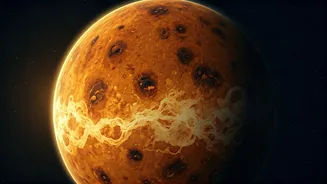
Let’s try to imagine this. Because of the combination of its slow spin and its orbit, the time from one sunrise to the next on Venus (known as a solar day) is actually different from its rotation period. One Venusian solar day lasts about 117 Earth days. This means you’d have roughly 58 days of continuous, searing daylight followed by 58 days of unending night. During the long day, surface temperatures can soar to 465°C, hot enough to melt lead. The thick, toxic clouds of sulfuric acid would permanently obscure the stars, creating a bleak, oppressive sky. The experience would be nothing short of a nightmare—a slow-motion ballet of planetary weirdness, where time itself feels broken. It serves as a powerful reminder that even our closest neighbours can be unimaginably alien worlds.