



A Truly Alien Calendar
On Earth, our sense of time is simple: a day is 24 hours, and a year is 365 days. But if you were to stand on the scorching surface of Venus, this fundamental concept would be turned upside down. Recent studies and long-standing data from space agencies
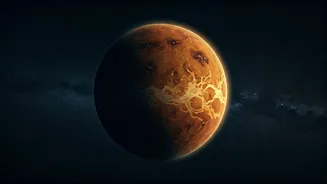
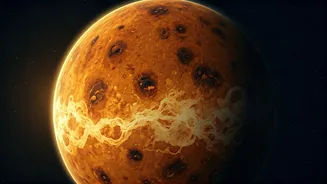
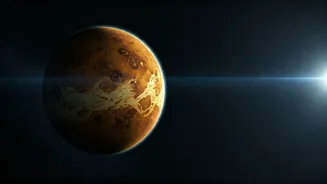
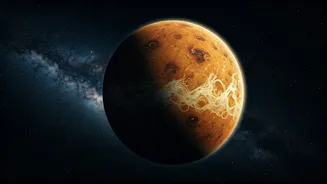
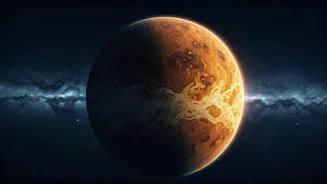
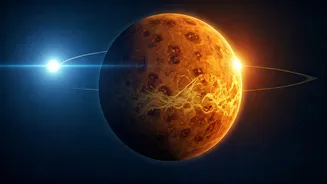
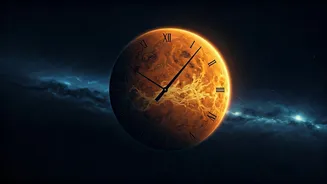
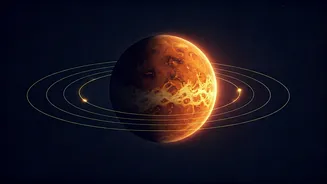
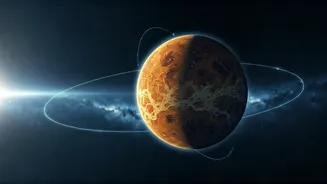
like NASA confirm one of the strangest facts in our solar system: a single day on Venus is longer than its entire year. To be precise, Venus takes about 225 Earth days to complete one orbit around the Sun (a Venusian year). However, it takes a staggering 243 Earth days for Venus to complete just one rotation on its axis (a sidereal Venusian day). It’s the only planet in our solar system where a day is longer than a year, making it a true astronomical outlier.
Understanding Day vs. Year
To grasp this mind-bending concept, it’s important to distinguish between a planet’s day and its year. A ‘year’ is defined by a planet's orbit—the time it takes to make one full journey around the Sun. Earth takes roughly 365 days, Mars takes about 687, and so on. A ‘day’ is defined by a planet’s rotation—the time it takes to spin once on its own axis. For Earth, that’s about 24 hours. The reason Venus’s calendar is so peculiar is that its rotation is incredibly, almost unbelievably, slow. While Earth is spinning at a brisk 1,670 kilometres per hour at the equator, Venus creeps along at a walking pace of just over 6 kilometres per hour. This glacial spin is the primary reason its day lasts so long.
The Added Twist of Retrograde Rotation
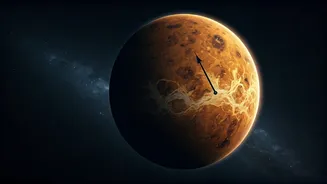
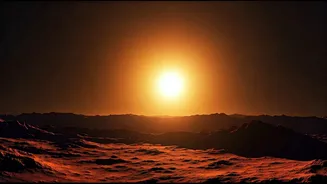
As if a day being longer than a year wasn't strange enough, Venus adds another layer of weirdness: it spins backward. Nearly every planet in our solar system, including Earth, rotates on its axis in a counter-clockwise direction when viewed from above the Sun's north pole. This is called prograde rotation. Venus, however, spins clockwise, a phenomenon known as retrograde rotation. (Uranus is the only other planet with a similarly strange rotation, as it’s tilted on its side). This backward spin has a curious effect. While a full rotation (sidereal day) takes 243 Earth days, the time from one sunrise to the next (a solar day) is much shorter, around 117 Earth days. Why? Because as Venus slowly spins backward, it is also moving forward in its orbit around the Sun. This combination means you would see the Sun rise in the west and set in the east, and you'd experience about two sunrises and sunsets for every Venusian year.
Why Is Venus So Strange?
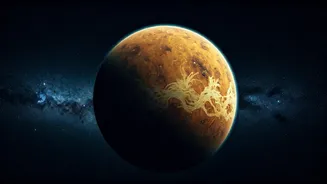
Scientists don't have a single, definitive answer for Venus’s peculiar rotation, but there are two leading theories. The first involves a colossal impact. Early in its history, a massive asteroid or protoplanet may have collided with Venus with such force that it reversed its spin and slowed it down dramatically. A 'planet-killer' event like this could have fundamentally altered its rotational dynamics forever. The second theory points to Venus's incredibly thick and heavy atmosphere. This dense blanket of gas, about 90 times thicker than Earth’s, could have created powerful atmospheric tides. Over billions of years, the gravitational pull of the Sun on this thick atmosphere, combined with friction between the atmosphere and the planet’s surface, could have acted as a brake, slowing its rotation to its current crawl and even eventually flipping it over.