






What Exactly Are eVTOLs?
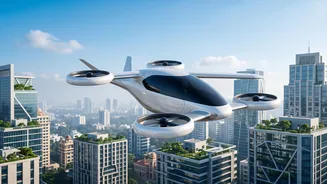
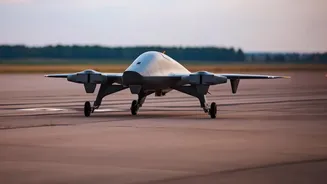
Think of an eVTOL—or electric Vertical Take-Off and Landing aircraft—as a sophisticated, quieter, and greener evolution of a helicopter. These all-electric vehicles are designed to transport a small number of passengers, typically between four and six,
over short to medium distances. Their key advantage is their ability to take off and land vertically like a helicopter, eliminating the need for long runways. This makes them ideal for urban environments where space is a premium. Powered by electricity, they promise zero operating emissions and a significantly lower noise footprint compared to traditional helicopters, making them better neighbours in densely populated cities.
The Promise for Indian Cities
India's rapidly growing cities are infamous for their traffic congestion, where even short distances can take hours to traverse by road. eVTTOLs offer a radical solution: a third dimension to urban transport. Companies like Archer Aviation project that a typical 60-to-90-minute car journey in Delhi could be reduced to about seven minutes by air. The initial focus for these air taxi services is on connecting major business hubs, airports, and city centres in places like Delhi, Mumbai, and Bengaluru. Beyond just saving time for commuters, this technology could also be used for critical applications like medical emergencies, cargo transport, and logistics, offering a versatile tool to improve urban efficiency.
The Key Players Taking Flight
The race to launch India's first air taxi service is already underway. InterGlobe Enterprises, the parent company of IndiGo, has made a significant move by signing a memorandum of understanding with US-based Archer Aviation. This partnership includes plans to acquire up to 200 of Archer's 'Midnight' aircraft to launch an all-electric air taxi service in India, potentially as early as 2026. Another key operator, Blade India, which already offers helicopter services, has partnered with Jaunt Air Mobility to launch eVTOL operations by 2027 and also has an agreement with Eve Air Mobility for up to 200 of its vehicles. Homegrown startups are also entering the fray, with companies like Bengaluru-based Sarla Aviation and the IIT Madras-incubated ePlane Company developing their own eVTOL prototypes.
Hurdles on the Horizon
Despite the excitement, the path to a sky full of air taxis is filled with challenges. The most significant is regulation. India's Directorate General of Civil Aviation (DGCA) and the Ministry of Civil Aviation are currently developing the entire regulatory ecosystem from the ground up. This includes rules for aircraft certification, pilot licensing, airspace management, and the design and operation of 'vertiports'—the landing pads for eVTOLs. Infrastructure is another major hurdle. Building a network of vertiports with charging capabilities across congested cities requires massive investment and careful urban planning. Finally, the service must be affordable enough to attract a wide user base beyond a niche luxury market, and the public will need to be convinced of its safety and reliability.
What Is the Path Forward?
The next few years are critical. The government is actively working on the policy framework, with a draft policy for urban air mobility expected to be finalised and the first certification applications accepted by the end of 2026. The initial services will likely be point-to-point routes connecting high-traffic corridors, such as between city centers and airports. Companies like InterGlobe and Blade India will work with partners to build the necessary infrastructure and train pilots. While early estimates targeted a 2026 launch, the complex interplay of regulation, infrastructure development, and aircraft certification means the timeline is ambitious. Successful trials and the establishment of a clear, robust regulatory framework will be the true indicators that India's urban mobility is ready to take to the skies.