




The First Alert
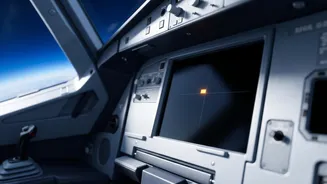
Long before a pilot might see or feel a problem, the aircraft itself knows something is amiss. Modern cockpits are equipped with sophisticated monitoring systems that act as a central nervous system. On Boeing aircraft, this is called EICAS (Engine Indicating
and Crew Alerting System), while Airbus uses ECAM (Electronic Centralized Aircraft Monitor). These systems use a series of screens to display data about the engines and other vital systems, replacing countless analogue dials. They continuously monitor for any abnormal conditions. When a fault is detected, the system alerts the crew with a specific combination of visual cues (like flashing lights or text messages) and aural warnings (chimes or even a synthetic voice), prioritizing the most critical information first. This ensures pilots aren't just reacting to a problem, but are immediately guided to its source and severity.
Aviate, Navigate, Communicate
This three-word mantra is drilled into every pilot from their first day of training and governs every action during an emergency. The first and most important priority is to “aviate”—fly the aircraft. Regardless of the problem, maintaining positive control is paramount. Once the flight path is stable, the next step is to “navigate.” This involves understanding the aircraft's position, assessing options, and deciding where to go, such as diverting to the nearest suitable airport. Only after the first two steps are under control does the pilot “communicate.” This means informing Air Traffic Control (ATC) of the situation, declaring an emergency if necessary (using terms like “Mayday” for grave and imminent danger or “Pan-Pan” for less urgent situations), and coordinating with the cabin crew. This strict prioritization prevents a manageable issue from escalating due to distraction.
The Power of Checklists
Human memory can be unreliable under stress. That's why aviation doesn't rely on it for critical procedures. Every commercial aircraft has extensive, rigorously tested checklists for almost any conceivable failure or emergency, from an engine fire to a loss of cabin pressure. When a problem occurs, pilots will turn to the Quick Reference Handbook (QRH) to find the appropriate checklist. This isn't just a simple to-do list; it's a step-by-step script that ensures every necessary action is performed correctly and in the right order. Often, one pilot (the Pilot Flying) will continue to fly the plane while the other (the Pilot Monitoring) reads the checklist aloud and confirms each action. This methodical, challenge-and-response process is a cornerstone of cockpit safety, minimizing the risk of human error when the pressure is on.
Designed for Failure: Redundancy
Commercial aircraft are built on a philosophy of redundancy. This means that no single failure should be catastrophic. Critical systems are duplicated or even triplicated. For example, an airliner might have three independent hydraulic systems; even if two fail, the aircraft can still be flown safely. Electrical power is sourced from multiple generators attached to different engines, backed up by an Auxiliary Power Unit (APU) and, in a worst-case scenario, a Ram Air Turbine (RAT) – a small propeller that drops down to generate emergency power from the airflow. This layered approach extends to computers, flight controls, and even the pilots themselves; the two-pilot system is the ultimate form of human redundancy.
When a Pilot is the Problem
One of the most challenging scenarios is pilot incapacitation, whether due to a medical issue or other cause. Procedures are in place for this as well. The remaining pilot is trained to take full control of the aircraft. Their first job is to ensure the incapacitated pilot is not interfering with the flight controls, which may involve securing their harness and moving their seat back. The pilot will then declare an emergency with ATC to get priority handling and assistance. Flight attendants are called to the cockpit to provide medical assistance and help manage the situation, and in some cases, one may be required to sit in the empty pilot seat to help with simple tasks like reading checklists. This ensures that even with half the flight crew, the aircraft can still be brought to a safe landing.