






Our Sun's Volatile Side
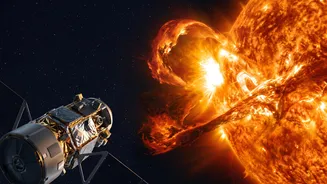
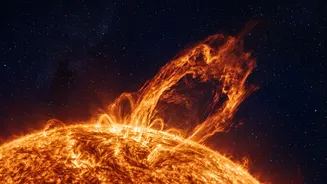
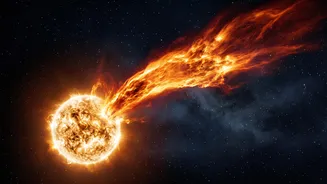
A solar storm, also known as a geomagnetic storm, occurs when the Sun ejects massive bursts of energy and plasma, called coronal mass ejections (CMEs). If Earth is in the path of a CME, these charged particles interact with our planet's magnetic field,
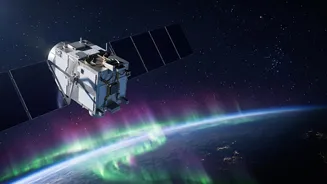
and the results can be both beautiful and dangerous. While they can create stunning auroras, these storms also have the power to induce powerful electrical currents in our infrastructure. In a worst-case scenario, a severe solar storm could overload power grids, causing widespread and long-lasting blackouts. They also pose a significant risk to the satellites we rely on for communication, navigation (GPS), and weather forecasting, and can disrupt radio signals used by airlines.
The Challenge of a Cosmic Speed Race
Predicting the exact impact of a solar storm has always been a race against time. While satellites can spot a CME as it leaves the Sun, it can take anywhere from 15 hours to several days for the particle cloud to reach Earth. This provides a general warning, but the critical information—exactly where the storm will hit and how intense it will be—has been much harder to pinpoint with significant lead time. Previous models could forecast local impacts or global trends, but not both quickly and accurately. The final, specific warning often came with very little time to spare, sometimes just minutes before the geomagnetic disturbance began, leaving little opportunity for infrastructure operators to prepare.
Enter DAGGER, the AI Forecaster
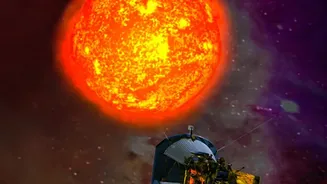
To address this challenge, an international team of researchers developed a new computer model called DAGGER, which stands for Deep Learning Geomagnetic Perturbation. This system combines artificial intelligence with real-time data from NASA satellites that monitor the solar wind—the stream of charged particles constantly flowing from the Sun. By training on vast amounts of satellite data, the AI learned to identify patterns in the solar wind that precede a geomagnetic storm on Earth. As a result, DAGGER can predict the location and severity of a solar storm's impact anywhere on the globe with up to 30 minutes of advance notice. The model is incredibly fast, capable of generating an updated forecast in less than a second.
Why 30 Minutes Is a Game-Changer
While a half-hour may not sound like much, in the world of infrastructure management, it's a critical window of opportunity. With a 30-minute warning, power grid operators can take proactive steps to protect their systems, such as rerouting power or taking sensitive transformers offline to prevent catastrophic failure. Satellite operators can put their spacecraft into a protective safe mode and adjust orbits to minimize damage from increased atmospheric drag. Airlines can alter flight paths, especially over polar regions where the effects of solar radiation are strongest. This crucial lead time allows for a shift from a reactive to a proactive defense, potentially saving billions of dollars in damages and preventing widespread disruption to modern life.