
An Old Friend in the Sky
Anyone who has looked up at the winter sky has likely seen the V-shape that forms the head of the bull in the constellation Taurus. This is the Hyades, the nearest open star cluster to Earth, located a mere 153 light-years away. For centuries, it has been
one of the most studied groups of stars, a perfect natural laboratory for understanding how stars are born and evolve together. Open clusters are families of stars, born from the same cloud of gas and dust around the same time, still loosely held together by gravity. The Hyades cluster is about 625 million years old, a teenager in cosmic terms, and its proximity and brightness have made it a cornerstone of astronomical research. We thought we knew it well.
The Decades-Long Hunt for Nothing
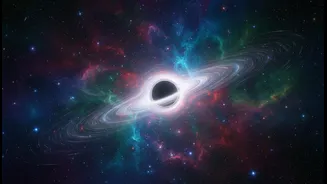
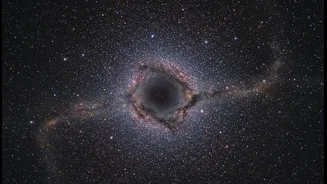
The latest chapter in the story of the Hyades is not about what we can see, but what we can't. For years, scientists have theorized that star clusters like this should contain stellar-mass black holes—the collapsed cores of massive stars that died long ago. Yet, finding them is a monumental challenge. A black hole, by its very nature, is invisible unless it is actively feeding on nearby material, which creates a bright show of X-rays. In a quiet, stable cluster like the Hyades, any black holes would be dark, lurking unseen among their bright siblings. The hunt was on for an object that emits no light, a ghost in a field of cosmic lighthouses. The only way to find it would be to trace its subtle gravitational influence on the stars around it.
A Symphony of Data and Simulation
This is where the 'slow-burn' nature of the discovery comes into play. The breakthrough didn't come from a single dramatic image but from the painstaking analysis of vast amounts of data collected over many years, primarily by the European Space Agency's Gaia satellite. Gaia's mission is to create a precise three-dimensional map of our galaxy, tracking the positions, movements, and velocities of billions of stars with incredible accuracy. A team of researchers led by Stefano Torniamenti at the University of Padua took this incredibly detailed observational data and compared it to sophisticated computer simulations. They ran thousands of N-body simulations, which are complex models that calculate the gravitational pull of every object on every other object over millions of years, to see how the Hyades cluster should have evolved under different conditions.
The Invisible Culprits
The scientists ran models with no black holes, and models with black holes of varying numbers and masses. They then checked which simulation best matched the real-world state of the Hyades as observed by Gaia. The results were compelling. The simulations that most accurately reproduced the current size and distribution of stars in the Hyades were those that included two or three stellar-mass black holes at its center. Without these invisible, massive objects tugging on the other stars, the cluster just didn't look right. The models suggest the black holes are either still lurking within the cluster or were ejected relatively recently—within the last 150 million years—because their gravitational signature still lingers on the cluster's structure. If confirmed, these would be the closest black holes to Earth ever found.
Rewriting the Stellar Story
This discovery, while still awaiting direct confirmation, is more than just a cosmic curiosity. It's changing how astronomers understand the life cycle of star clusters. The presence of black holes can significantly alter how a cluster evolves, affecting its stability and how its stars are distributed. According to astrophysicist Mark Gieles, these findings help us understand how black holes are distributed across the galaxy and how star clusters contribute to sources of gravitational waves, the ripples in spacetime first detected in 2015. Each time a pair of black holes merges, it sends out these waves, and clusters like the Hyades might be a prime factory for producing such pairs. This research provides a new and promising method for finding these hidden giants in other star clusters, using the stars themselves as breadcrumbs.