


A New Cosmic Masterpiece
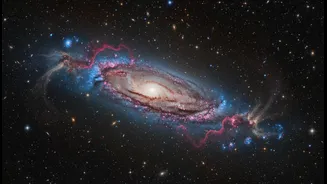
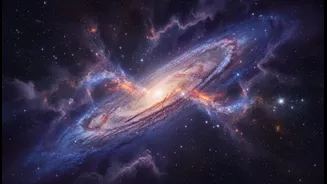
The latest release from the joint NASA/ESA/CSA James Webb Space Telescope (JWST) captures the galaxy Centaurus A in mesmerising detail. Located a relatively close 11 million light-years away, this galaxy is a hotbed of scientific intrigue. The image reveals
a densely packed tapestry of millions of individual stars, something that was impossible with previous telescopes whose views were obscured by thick lanes of cosmic dust. What makes Centaurus A so fascinating is its dramatic past; it's the result of a colossal collision between two galaxies billions of years ago. This merger has left it with an unusual structure and an intense burst of ongoing star formation, making it a perfect laboratory for studying how galaxies evolve. The new image cuts through the chaos, transforming a familiar galaxy into a landscape far richer and more complex than ever seen before.
The Technology Behind the View
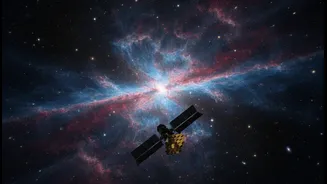
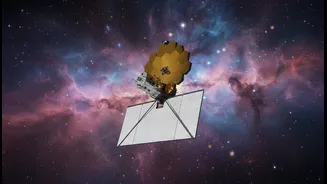
This unprecedented view is made possible by the James Webb Space Telescope's powerful infrared instruments. Unlike the Hubble Space Telescope, which primarily sees visible light, Webb is designed to detect infrared light. This capability is crucial because as the universe expands, light from the most distant objects gets stretched into longer, redder wavelengths—a phenomenon called redshifting. Webb’s giant, 6.5-metre gold-coated mirror, more than five times the area of Hubble's, allows it to collect vast amounts of this faint, ancient light. Furthermore, its infrared vision allows it to peer through the dense clouds of gas and dust that act like cosmic curtains, hiding stellar nurseries and galactic cores from view. This technological leap allows astronomers to see not just new objects, but new details within familiar ones, revealing the universe's hidden architecture.
What Scientists Are Learning
These images are far more than just pretty pictures; they are data-rich goldmines for astronomers. By resolving millions of individual stars in Centaurus A, scientists can now engage in a kind of galactic archaeology. They can study stars of different ages to reconstruct a timeline of the galaxy's evolution, pinpointing when bursts of star formation occurred following the ancient collision. The image also reveals strange and perplexing new details, like a mysterious S-shaped dust structure near the galaxy's core, whose origins are not yet understood. At the center of Centaurus A is an active supermassive black hole, and Webb's data shows how it launches powerful jets that shape the surrounding galaxy. This provides crucial evidence for how black holes can both trigger intense star birth by compressing gas and also 'kill' a galaxy by blowing away its raw material.
A Global Effort for a Universal View
The James Webb Space Telescope is a testament to international collaboration, a joint mission of NASA, the European Space Agency (ESA), and the Canadian Space Agency (CSA). Its success represents decades of work by thousands of engineers and scientists across the globe. This partnership combines resources, expertise, and perspectives, enabling a scientific instrument of a scale and complexity that no single nation might have achieved alone. Each new image release is a shared human achievement, providing data and discoveries that are open to the global scientific community. This collaborative approach accelerates our collective understanding of the cosmos, reminding us that the quest for knowledge about our universe is a journey that transcends national borders.
The Next Frontier in Space Imaging
While the new view of Centaurus A is a landmark, it's just one part of Webb's ongoing mission to revolutionise astronomy. The telescope's instruments are also being used to probe the atmospheres of distant exoplanets, searching for the chemical building blocks of life. Recent observations have detected molecules like methane and even signs of clouds on planets orbiting other stars, including one orbiting a dead star. Webb is also pushing the boundaries of cosmology, identifying some of the earliest galaxies ever formed, just a few hundred million years after the Big Bang. Each observation builds on the last, adding another piece to the puzzle of cosmic history. The clarity and depth provided by Webb mean that for astronomers, the age of discovery has just been supercharged.