



Who Is Eka Robotics?
Eka Robotics is a startup building general-purpose robots designed to perform complex physical tasks that have, until now, been the exclusive domain of human hands. Founded by specialists from institutions like MIT and Google DeepMind, the company is tackling
one of the biggest challenges in robotics: dexterous manipulation. Their mission is to create intelligent systems that can handle the variability and unpredictability of the real world, from sorting delicate items in a warehouse to performing intricate assembly tasks on a factory floor. Unlike many robotics firms that rely on teaching robots to mimic human actions, Eka is focused on making its robots 'master physics' through a unique AI model. This allows them to adapt to tasks with a level of intuition, rather than just following pre-programmed instructions.
The Breakthrough Technology
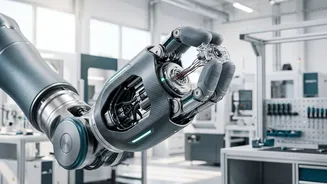
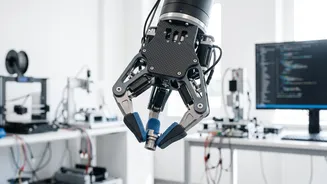
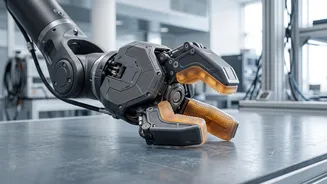
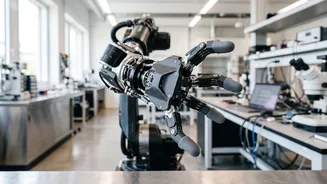
At the heart of Eka's innovation is its Vision-Force-Action (VFA) model. This system combines computer vision (what the robot 'sees') with advanced force sensors in its custom-built grippers (what the robot 'feels'). This tactile feedback is a game-changer; it allows the robot to sense if an object is slipping and adjust its grip in real-time, a crucial skill for reliability. Instead of being trained on massive datasets of human demonstrations, Eka’s robots learn through trial and error in a physics simulator using a process called reinforcement learning. This method allows the company to generate thousands of hours of robot experience in mere minutes, rapidly teaching the AI how to handle a vast array of objects and situations before applying those skills to physical hardware.
Details of the Landmark Investment
The $150 million Series A round was co-led by prominent venture capital firms Andreessen Horowitz (a16z) and F-Prime, with participation from previous investors and several other strategic partners. This substantial funding places a post-money valuation on Eka Robotics at an impressive $1.45 billion. The investment is one of the largest of its kind for a company in the 'physical AI' space, signaling strong investor belief that after advancements in software AI like ChatGPT, the next frontier is intelligent machines that can perform physical work. According to the company, the capital will be used to scale its technology, expand the range of tasks its robots can perform, and significantly accelerate deployments to customers.
Scaling Deployments and Performance
With the new funds, Eka plans to move its robots from promising pilots to widespread commercial use. The company is already conducting early tests with unnamed industrial customers on tasks like picking and placing objects and handling wires. The goal is to prove their systems can operate reliably and consistently on real factory floors. Eka claims its robots can already pick unfamiliar objects at a rate of 1,500 operations per hour, more than double the human baseline of around 600, with a success rate of over 95%. The challenge now is to maintain that performance over long periods in demanding industrial environments. The funding will be crucial for refining the hardware, like its custom gripper, and scaling up production to meet commercial demand from the logistics, manufacturing, and warehouse automation sectors.
The Bigger Picture for India's Tech Scene
While Eka Robotics is based in the US, its success resonates deeply with India's burgeoning automation industry. India is already one of the top 10 global markets for industrial robotics, with installations growing rapidly. The market is projected to expand significantly, driven by government initiatives promoting manufacturing and the need for greater efficiency in sectors like automotive, electronics, and logistics. The success of a high-tech venture like Eka, founded by individuals with strong academic and industry pedigrees, provides a powerful blueprint for India's own deep-tech startups. The technologies Eka is pioneering—combining AI, simulation, and advanced hardware—are directly applicable to solving challenges within India's rapidly industrialising economy, where the demand for sophisticated automation is surging.