
An Erratic Orbit
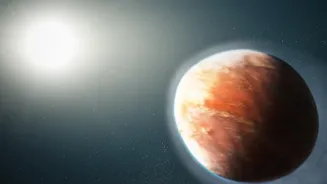
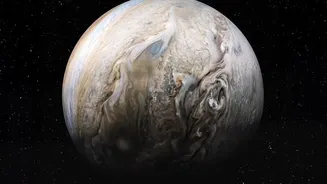
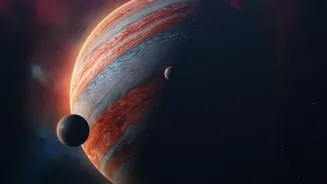
The story begins with a planet named TOI-2535 b, a 'hot Jupiter' located about 1,000 light-years from Earth. Discovered by NASA's Transiting Exoplanet Survey Satellite (TESS), it was found using the 'transit method', which detects the tiny dip in a star's
light as a planet passes in front of it. For seven years, from 2019 to early 2026, TESS watched TOI-2535 b complete its blisteringly fast 8.25-day orbit. But something was odd from the start. Unlike the clockwork precision of most planetary orbits, this one was wildly unpredictable. The planet often arrived at its transit point up to six hours early or six hours late, a major red flag for astronomers who rely on regularity.
The Vanishing Act
The puzzle deepened dramatically in March 2026. After years of its erratic behaviour, TOI-2535 b stopped showing up altogether. The dips in starlight that TESS had been monitoring simply ceased. From our vantage point on Earth, the planet had effectively vanished without a trace. Planets don't just disappear, so astronomers were faced with a compelling 'whodunnit' on a cosmic scale. Had the planet been destroyed in some cataclysmic event? Or had it been flung out of its solar system entirely? The absence of evidence became the central clue in a baffling new case for space detectives.
A Hidden Accomplice
Now, a team of astronomers has decoded the mystery, and the solution is as elegant as it is dramatic. The planet didn't vanish at all; it was pulled out of sight by an unseen accomplice. New research reveals that TOI-2535 b is not alone. It has a massive, hidden neighbour whose gravitational pull is playing havoc with its orbit. According to researchers, this unseen planet is exerting such a strong gravitational force that it's fundamentally altering the path of TOI-2535 b. The 'disappearance' wasn't an explosion or an escape, but a subtle shift that hid the planet from our view.
The Cosmic Wobble
The interaction between these two worlds has created the most extreme orbital 'wobble' ever witnessed by astronomers. Think of two spinning tops near each other; their movements influence one another. In this system, the gravitational tug-of-war between TOI-2535 b and its hidden companion is causing the orbital plane of both planets to tilt dramatically over time. This rapid tilting is what caused the transits to first become irregular, then shallower, and finally to stop completely. The planet's orbit has been tipped so far out of alignment with our line of sight that it no longer crosses the face of its star from our perspective.
Gone for Now, but Not Forever
So, where does that leave the 'disappeared' planet? It's still there, faithfully orbiting its star every eight days, but it's now hidden from the transit method of detection. According to the team's calculations, the orbital wobble is so severe that TOI-2535 b won't transit its star again for at least another 30 years. This remarkable event challenges the idea of solar systems as perfect, clockwork mechanisms, revealing them to be dynamic and interactive places. While we wait for TOI-2535 b to reappear, astronomers have a new target: its hidden neighbour. As it continues its own cosmic wobble, that mysterious second planet might just drift into view, giving us our first direct look at the culprit.