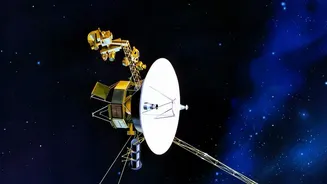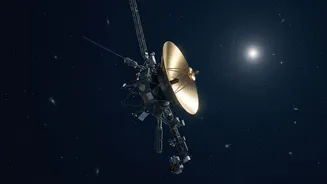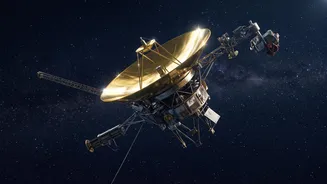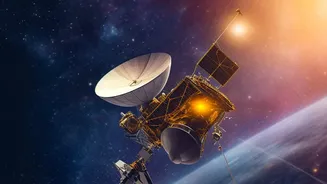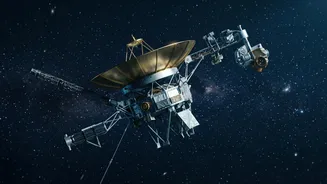

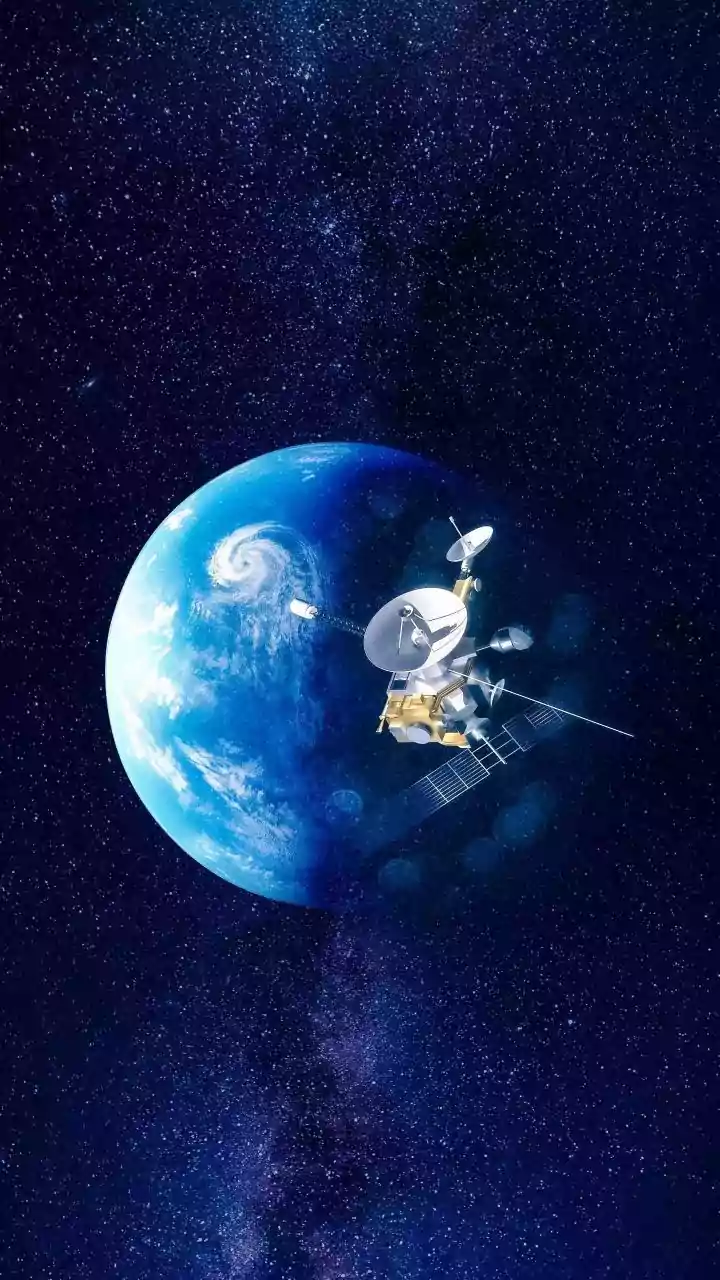
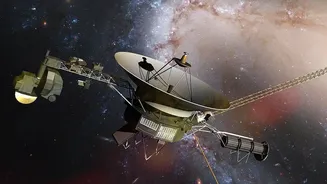
After nearly 50 years trekking through the cosmos, NASA's Voyager 1 probe has hit a staggering milestone. It is now one light-day from Earth, the first time any human-made object has ever been so far away. It's a testament to human ingenuity.
Putting a Light-Day in Perspective
So, what
exactly is a light-day? It's the distance that light, the fastest thing in the universe, travels in 24 hours. That equates to roughly 25.9 billion kilometres (16.1 billion miles). To put that into context, light takes about 1.3 seconds to get from Earth to the Moon and a little over eight minutes to travel from the Sun to us. A signal sent from Earth to Voyager 1 now takes a full day to arrive, meaning a simple round-trip communication requires 48 hours. At its current speed of about 61,000 km/h (38,000 mph), it took Voyager 1 almost half a century to cover a distance that light crosses in a single day.
The Grand Tour and Beyond
Launched on September 5, 1977, sixteen days after its twin, Voyager 2, the primary mission for Voyager 1 was to study Jupiter and Saturn. It revealed Jupiter’s faint ring system and active volcanoes on its moon Io, and at Saturn, it explored the planet's complex rings and the dense atmosphere of its giant moon, Titan. After its Saturn flyby in 1980, a gravitational assist flung it onto a path out of the solar system. In 2012, Voyager 1 made history by crossing the heliopause—the boundary where the Sun's influence ends—and entering interstellar space, the vast expanse between the stars. It has been humanity's most distant object since overtaking the Pioneer 10 probe in 1998.
Humanity's Mixtape to the Stars
Bolted to the side of Voyager 1 is a special artifact: the Golden Record. This 12-inch, gold-plated copper disk is a time capsule, a message in a bottle intended for any intelligent extraterrestrial life that might one day encounter the silent probe. Assembled by a committee led by famed astronomer Carl Sagan, the record contains 116 images, a variety of natural sounds like wind and whale songs, musical selections from different cultures and eras, and spoken greetings in 55 languages. It also holds a printed message from then-US President Jimmy Carter and a recording of the brainwaves of writer Ann Druyan, who later married Sagan. It is a portrait of our world, a gesture of peace and curiosity sent into the galactic dark.
An Aging Explorer in the Void
Keeping a nearly $50$-year-$old$ spacecraft functioning in the frigid environment of interstellar space is a monumental challenge for NASA engineers. The probe's plutonium power source is dwindling, losing about four watts of power per year, and its computers have less memory than a modern car key fob. To extend its life, NASA has been methodically shutting down non-$essential$ instruments to conserve energy and keep its remaining science tools warm enough to operate. Despite these efforts and occasional communication glitches, the probe continues to send back valuable data about the interstellar medium at a data rate of just $160$ bits per second, which is then picked up by the massive dishes of the Deep Space Network.