


Earth: The Ultimate Cosmic Laboratory
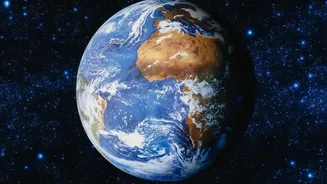
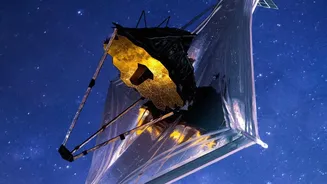
The quest to find life beyond Earth is one of humanity's greatest scientific endeavors. While rovers crawl across Mars and telescopes peer at distant exoplanets, much of the foundational work happens in our own backyard. Planetary scientists use locations
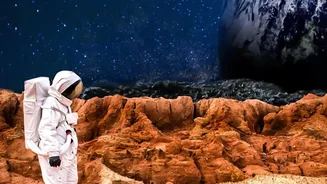
on Earth that mimic the conditions of other planets and moons. These places are called 'planetary analogs'. Sending missions to other worlds is incredibly expensive and difficult, so studying similar geologic processes and environments on Earth provides a practical and accessible way to prepare. By understanding how geology and even life works in these harsh stand-in environments, scientists can better interpret the data sent back from robotic explorers and design more effective future missions.
Reading the Red Planet in the Driest Deserts
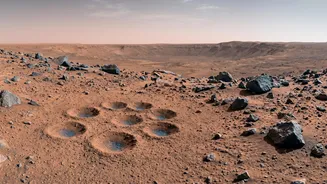
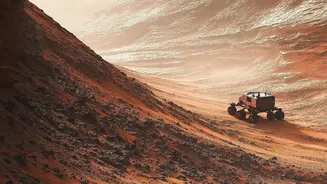
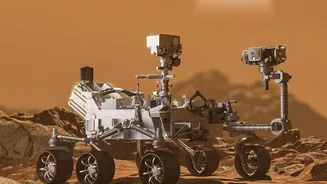
Mars is a primary target in the search for past or present life. To understand it, scientists travel to some of the driest places on Earth, most notably the Atacama Desert in Chile. This desert is an exceptional Mars analog because of its extreme dryness, Mars-like soil chemistry, and high levels of ultraviolet radiation that are similar to the Martian surface. Here, in a place that can go decades without significant rain, researchers test technologies for future missions. For instance, NASA's Atacama Rover Astrobiology Drilling Studies (ARADS) project used a rover to test autonomous drilling and life-detection instruments. By drilling into the soil, scientists hope to find microbes that have escaped the harsh surface conditions, giving them a strategy for how and where to look for potential biosignatures buried just beneath the surface of Mars.
Exploring Icy Moons in Earth's Poles
Beyond Mars, some of the most promising locations for life are the 'ocean worlds' of our solar system, like Jupiter's moon Europa and Saturn's moon Enceladus. These moons are covered in thick ice shells but are believed to harbor vast liquid water oceans underneath. The closest analogs we have for these frigid, dark environments are Earth's polar regions. Antarctica, in particular, serves as a crucial testing ground. Scientists study subglacial lakes like Lake Vostok, which have been isolated from the atmosphere for millennia, to understand how life might survive in total darkness and extreme cold. Recently, researchers deployed advanced seismometers on an Antarctic ice shelf to test their ability to operate on icy moons, hoping one day to use similar technology to probe the interiors of these distant worlds for habitable conditions.
The Lessons of Extremophiles
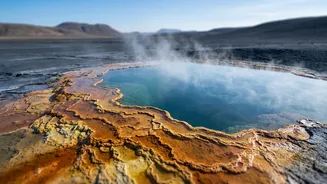
A key reason these analog sites are so valuable is the life that manages to survive there. These organisms, known as 'extremophiles', thrive in conditions that would be lethal to most life, from extreme heat and cold to high radiation and acidity. Studying them has completely changed scientists' ideas about the conditions necessary for life. For example, bacteria discovered in the Atacama that survive on just atmospheric moisture prove that life can persist in Mars-like conditions. Finding life in deep-sea vents, where sunlight never reaches, gives hope that similar ecosystems could exist at the bottom of Europa's hidden ocean. These tenacious microbes show us the absolute limits of life as we know it, expanding the range of environments we consider potentially habitable across the galaxy.
From Field Test to Flight Ready
The research conducted at these analog sites is not just theoretical. It directly informs the design and operation of multi-billion dollar space missions. Testing instruments in a dusty, rocky desert helps engineers build more robust rovers. Understanding how to detect microbial life in Antarctic ice helps refine the tools that will one day search for life on Europa. When scientists use ground-penetrating radar to find lava tubes in Iceland—which could serve as shelters for future astronauts on the Moon or Mars—they are proving a technique that can be used on another world. Every piece of 'ground truth' data collected on Earth makes our remote sensing of other planets more accurate and our search for extraterrestrial life more focused and efficient.