




A Perpetual Tug of War
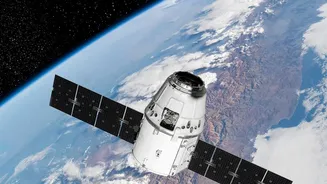
The secret to a satellite's orbit lies in a perfect balance between its forward speed and the constant pull of Earth's gravity. Think about throwing a ball. The harder you throw it, the farther it travels before gravity pulls it to the ground. Now, imagine
throwing that ball so incredibly fast that as it falls, the Earth's surface curves away from it at the same rate. The ball would be continuously falling, but it would never actually hit the ground. This is precisely what happens with a satellite. It is launched with enough velocity to keep moving forward, while gravity provides the exact amount of pull needed to bend its straight path into a curved orbit around the planet.
Finding the 'Goldilocks' Speed
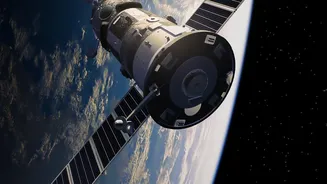
A satellite's velocity is critical. If it travels too slowly, Earth's gravity will win the tug-of-war, and the satellite will spiral back down into the atmosphere. If it travels too fast, it will overcome gravity's pull and escape into space. The required speed, known as orbital velocity, depends on the satellite's altitude. For a satellite in Low Earth Orbit (LEO), about 200 kilometres up, the necessary speed is a blistering 28,000 kilometres per hour. Higher orbits require less speed. For example, a satellite in a geostationary orbit 35,786 kilometres high travels at a more leisurely 11,300 kilometres per hour. At this specific altitude and speed, the satellite's orbital period matches Earth's 24-hour rotation, making it appear to hang motionless over one spot, which is ideal for communications and weather satellites.
An Endless State of Falling
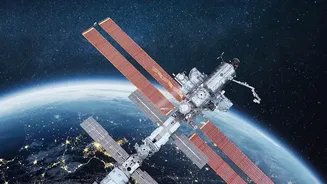
It might sound strange, but an orbiting satellite is in a constant state of freefall. Just like an elevator when the cable snaps, everything inside the satellite is falling together. This is why astronauts on the International Space Station (ISS) experience weightlessness. It’s not because there is no gravity—in fact, the gravity at the ISS's altitude is about 90% as strong as it is on the surface. Rather, because the station and everything in it are continuously 'missing' the Earth as they fall, there is no ground force to push back up and create the sensation of weight. They are simply falling around the planet at thousands of kilometres per hour.
Why Orbits Aren't Forever
While satellites in high orbits can remain there for centuries, those closer to Earth face a persistent enemy: atmospheric drag. Even hundreds of kilometres up, there are still traces of Earth's atmosphere that create a tiny amount of friction. This drag slowly saps energy from the satellite's motion, causing its altitude to gradually decrease in a process called orbital decay. As the satellite sinks lower into denser atmosphere, the drag increases, accelerating the decay until the satellite eventually re-enters the atmosphere and burns up. To counteract this, satellites in LEO, including the ISS, must periodically fire small thrusters to boost themselves back to their proper altitude, extending their operational lives.