







The Allure of the Single, Simple Label
We live in a world of information overload. When faced with a dozen tempting menu items, a simple, reassuring word like 'healthy', 'low-fat', or 'natural' can feel like a life raft. It simplifies our decision-making process, allowing us to order quickly
and feel good about our choice. For years, public health advocates have pushed for menu labelling, believing it empowers consumers. The theory is straightforward: if people know what’s in their food, they’ll choose better options. However, studies show that while consumers want this information, many find existing labels confusing or difficult to understand in the moment. This desire for clarity often leads us to rely on single-word descriptions, but these labels can hide a much more complicated nutritional story.
When ‘Healthy’ Hides the Truth
The word 'healthy' is perhaps the most common and most misleading label. A dish can be built around a core of healthy ingredients, like grilled chicken and fresh greens, but that doesn't account for the entire plate. A creamy, high-fat dressing, a pile of cheese, candied nuts, or crispy croutons can quickly transform a 'healthy' salad into a calorie-dense meal that rivals a burger and fries. The single label often fails to capture the impact of cooking methods—a piece of fish, healthy on its own, becomes a different nutritional proposition when it's deep-fried. The same goes for sauces and sides, which can add significant amounts of sodium, sugar, and saturated fats that aren't reflected in a simple, positive-sounding label. This makes it incredibly difficult for diners to get an accurate picture of what they are actually consuming.
The Problem with Other Buzzwords
It’s not just the word 'healthy' that can cause confusion. Other labels, like 'natural', are often used as marketing tools with little to no regulated meaning. A recent study from the University of Massachusetts Amherst found no consistent nutritional advantage for products labeled as 'natural'. Similarly, terms like 'low-fat' or 'sugar-free' can create a 'health halo', where we perceive the entire dish as virtuous and may even end up eating more of it. A 'low-fat' muffin might have its fat content reduced, but its sugar content could be increased to maintain flavour. A 'sugar-free' dessert might use artificial sweeteners, the long-term health effects of which are still debated. These labels focus on a single nutrient, ignoring the overall composition of the meal.
A Smarter Way to Label
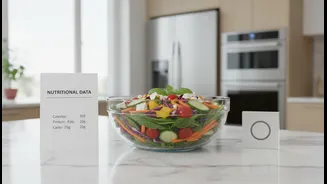
So, if single labels are failing us, what’s the alternative? The research is pointing toward more comprehensive 'nutrient profiling systems' (NPS). Instead of one word, these systems might use a scoring method or a 'traffic light' system (red, yellow, green) to give a more holistic view of a meal's nutritional value. These models look at multiple factors, balancing beneficial components like protein and fibre against things that should be limited, like sodium, sugar, and saturated fats. This provides a much more nuanced snapshot of a food's healthfulness. While common for packaged foods in some countries, this approach is still rare in restaurants, largely due to the complexity and cost of analysing every dish, especially with menu variations and chef creativity.
How to Decode Your Menu Like a Pro
Until multi-faceted labelling becomes the norm, you have the power to be a more discerning diner. First, look past the single-word label and read the description. What are all the ingredients? Second, don't be afraid to ask questions. How is the dish prepared—is it fried, grilled, or steamed? Can the sauce or dressing be served on the side? Third, pay attention to portion sizes, which are often much larger in restaurants than what you’d serve at home. Finally, remember that context matters. The goal isn't to find a 'perfect' meal, but to make an informed choice that fits your needs. Simply being aware that a 'healthy' label doesn't tell the whole story is a huge step in the right direction.