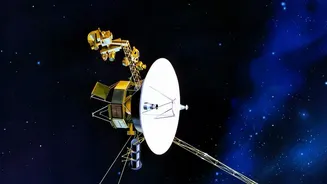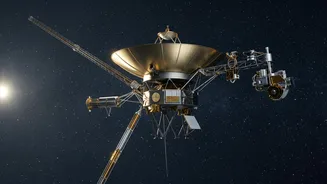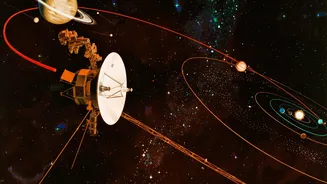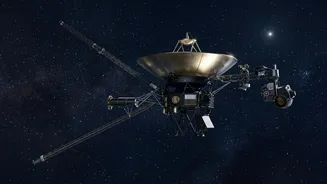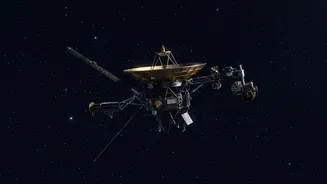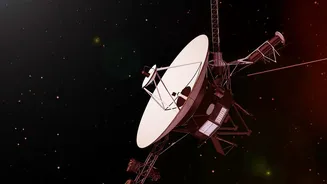



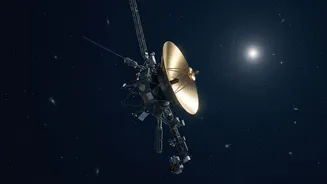
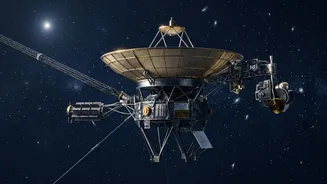
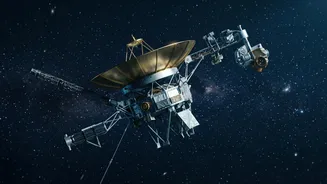
Humanity’s most distant emissary, NASA's Voyager 1, is about to cross a threshold that redefines distance. After nearly 50 years, it will be one light-day from Earth, a testament to enduring engineering and our unyielding curiosity.
A New Definition of Far
On November 18, 2026,
a machine launched in 1977 will be so far away that it will take a full 24 hours for its radio signals, travelling at the speed of light, to reach us. This distance, known as a light-day, is approximately 25.9 billion kilometres. To put that into perspective, light from the Sun reaches Earth in about eight minutes; a signal to the most distant planet, Neptune, takes over four hours. Voyager 1's achievement places it in a league of its own, a lonely outpost in the vast cosmic ocean. The milestone is a quiet one—the spacecraft itself will be unaware—but for us on Earth, it's a profound moment to reflect on the scale of the universe and the tenacity of this little probe.
The Grand Tour That Never Ended
Launched on September 5, 1977, sixteen days after its twin, Voyager 2, Voyager 1 took a faster, more direct route to the outer solar system. Its primary mission was a 'Grand Tour' of Jupiter and Saturn, taking advantage of a rare planetary alignment. In 1979, it revealed the first active volcanoes beyond Earth on Jupiter's moon, Io. In 1980, it flew past Saturn, providing unprecedented views of its complex ring system and hazy moon, Titan. After that, its planetary mission was over, but its journey was just beginning. In 1998, it officially became the most distant human-made object, surpassing Pioneer 10. Then, in August 2012, it made history by becoming the first spacecraft to enter interstellar space, crossing the boundary known as the heliopause where the Sun's influence ends.
A Long-Distance Call Home
Communicating with a spacecraft nearly 50 years old and billions of kilometres away is a monumental challenge. The probe's nuclear power source, which converts heat from decaying plutonium, weakens by about four watts each year. Ingenious NASA engineers have been finding creative ways to conserve energy, such as a recent manoeuvre nicknamed the 'Big Bang' that swapped to lower-power devices to keep its remaining instruments warm and operational. The mission has not been without drama. In late 2023, the probe began sending back gibberish for five months before engineers devised a clever fix. More recently, in October 2026, it went silent for 48 hours before spontaneously resuming communication, a move that the mission team is still investigating. Each successful command and data return is a triumph, requiring a two-day round trip for a signal to be sent and a response received.
A Message in a Cosmic Bottle
Beyond its scientific instruments, Voyager 1 carries a message for any civilization that might one day find it: the Golden Record. This gold-plated copper disk is a time capsule of Earth in 1977. Assembled by a committee led by famed astronomer Carl Sagan, it contains 116 images, a variety of natural sounds like wind and whale song, and music from different cultures and eras, including Bach and Chuck Berry. It also holds spoken greetings in 55 languages, the brainwaves of writer Ann Druyan, and a message of peace from then-U.S. President Jimmy Carter. Sagan described the record as a 'bottle' launched into the 'cosmic ocean', a hopeful statement about life on our planet. While the chances of it being found are infinitesimal, its presence on the spacecraft speaks volumes about our desire to connect and be remembered.