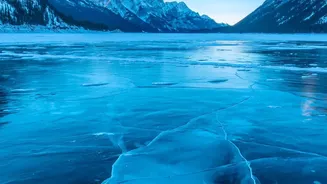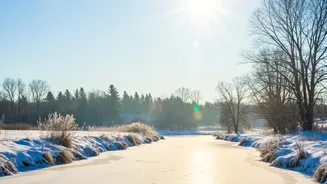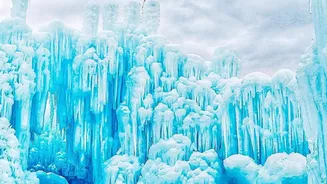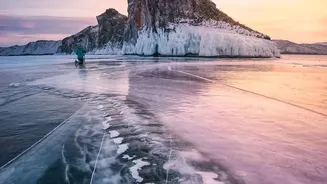


When a lake's surface freezes, it can become a canvas for nature’s most stunning and curious artwork. These intricate patterns, from stacked bubbles to geometric cracks, are more than just beautiful; they are visual stories of physics and chemistry.
The Science of a Freeze
Before
any pattern can form, a lake must first freeze. This process begins as autumn air cools the lake's surface. The colder, denser water sinks, pushing warmer water up. This cycle continues until the entire lake reaches about 39 degrees Fahrenheit (4°C), the temperature at which water is most dense. As the surface water cools further, its molecules spread out, making it less dense and allowing it to float on top. Once it hits 32°F (0°C), ice crystals form a lattice, creating a sheet of ice that grows thicker as long as the air above remains cold. This solid canvas is where the real artistry begins.
Trapped Methane Bubbles
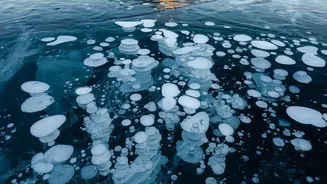
One of the most photographed phenomena is the sight of white bubbles seemingly suspended in stacks within clear ice. These aren't air bubbles but are actually methane gas. At the bottom of many lakes, organic matter like plants and animals decompose, a process during which bacteria release methane. In warmer months, this gas simply bubbles up and escapes into the atmosphere. But in winter, as the lake freezes, the rising bubbles get trapped. As the ice sheet thickens downwards, successive bubbles are caught, creating mesmerising vertical columns that serve as a visual record of gas released over time. While beautiful, this phenomenon is also a point of scientific study, as methane is a potent greenhouse gas released when the ice thaws.
Delicate Frost Flowers
Under very specific and rare conditions, a frozen lake can bloom with 'frost flowers'. These are not flowers, but delicate, feathery ice crystal formations that grow on the surface of new, thin ice. They form when the air is much colder than the ice surface—often a difference of at least 15-20°C—and the air is calm. Moisture from the warmer ice sublimates (turns from solid to gas) into the frigid air above, which becomes supersaturated. This water vapour then condenses and freezes onto tiny imperfections on the ice surface, growing into intricate, spiky clusters that resemble blossoms. These formations are incredibly fragile and often disappear with the slightest wind or a rise in temperature.
Pancakes and Perfect Circles
Not all ice formations are stationary. In slow-moving rivers or large lakes with currents, two other curious patterns can emerge: ice pancakes and ice circles. Pancake ice consists of circular slabs of ice, often with raised edges. They form in slightly agitated water, where newly formed slush or ice floes bump into each other. As they collide, the edges get worn down and slush splashes up, freezing into a distinctive rim. Ice circles, or ice discs, are rarer. They are single, large, slowly rotating discs of ice. These often form in river bends where a whirlpool-like eddy is created. A piece of ice can get caught in this current, and as it spins, its edges are ground smooth against the surrounding stationary ice, forming a near-perfect circle.
The Art of the Crack
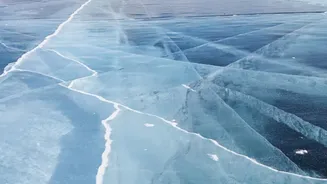
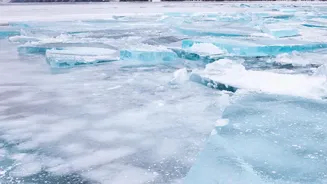
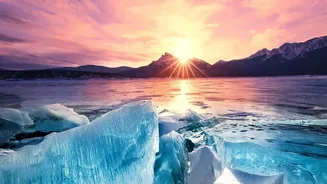
The booming and cracking sounds heard on a frozen lake are the sounds of the ice sheet adjusting to stress, often creating patterns of their own. Rapid temperature changes are a primary cause. When the air gets very cold, the top layer of ice contracts, creating tension that leads to long, straight cracks. Conversely, when the ice warms, it expands. With nowhere to go, this pressure can cause the ice sheet to fracture, sometimes pushing upwards into ridges. These fractures can create vast, geometric networks across the ice. Under specific conditions, complex fractal patterns, sometimes called 'ice stars', can form on clear 'black ice' when water from below seeps up through micro-cracks and refreezes in a dendritic, star-like pattern.