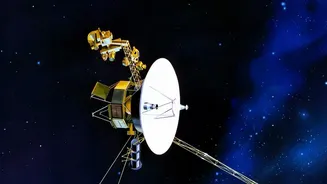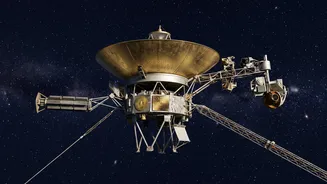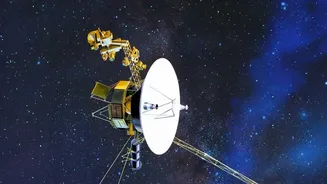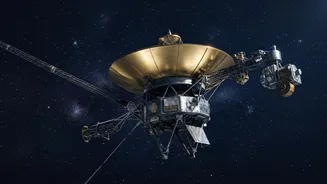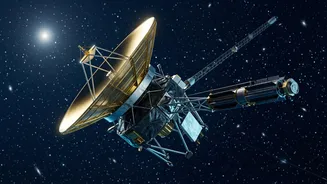



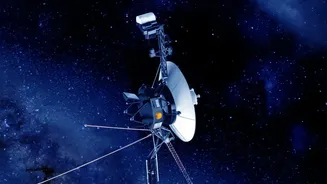
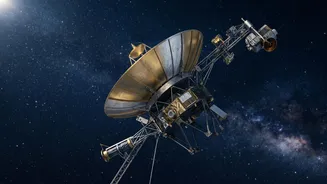
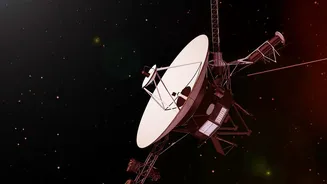
After nearly 50 years in space, Voyager 1 is full of surprises. Humanity’s most distant creation went silent for 48 hours in October, only to spring back to life on its own, leaving engineers at NASA both relieved and mystified.
A Sudden Silence from Deep Space
On October 18 and 19, 2026,
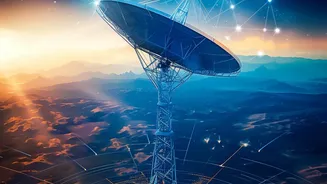
routine check-ins with Voyager 1 by NASA's Deep Space Network yielded nothing but silence. For two days, the signal from the intrepid explorer, now traveling through interstellar space, was gone. For the mission team at the Jet Propulsion Laboratory (JPL), it was a tense 48-hour period. At its incredible distance, a command sent from Earth takes nearly 24 hours to reach the spacecraft, and another 24 hours are needed to receive a response. This meant there was no way to send a quick fix; engineers on the ground could only wait and hope.
A Ghost in the Machine
Then, on October 20, before the ground team could even send a formal recovery command, Voyager 1's signal reappeared. It had, for all intents and purposes, fixed itself. Telemetry data soon revealed what had happened onboard. The spacecraft's autonomous fault protection system had detected an issue with the primary set of thrusters, which are crucial for keeping its main antenna pointed toward Earth. Following its 1970s-era programming, the system automatically switched to a backup set of thrusters, putting the probe into a stable 'safe mode' and, shortly after, re-establishing contact. This was the first time the spacecraft had performed such a corrective maneuver entirely on its own.
Engineers Unravel the Mystery
While the self-correction was a welcome surprise, NASA engineers are still investigating the root cause of the initial problem. In a statement, Voyager Mission Manager Kareem Badaruddin noted that while this was a new kind of event, the team must 'expect the unexpected' at this advanced stage of the mission. The incident is another chapter in a series of late-life challenges for the resilient probe. In late 2023, Voyager 1 began sending back garbled data due to a corrupted memory chip, a problem engineers cleverly solved months later by splitting up the affected software code and storing it in different locations. These issues highlight the increasing difficulties of operating a nearly 50-year-old computer system battered by decades of cosmic radiation.
The Enduring Legacy of Voyager
Launched in 1977, Voyager 1 and its twin, Voyager 2, completed a 'grand tour' of the outer planets, providing the first and, in some cases, only closeup views of Jupiter, Saturn, Uranus, and Neptune and their moons. After its planetary mission, Voyager $^$1’s trajectory took it out of the plane of the solar system. In $^$2012$, it became the first humanmade object to enter interstellar space, the region between the stars. It continues to send back invaluable data about this unexplored territory, running on a plutonium power source that diminishes by about four watts each year. To extend its life, engineers periodically shut down instruments and heaters in complex powersaving maneuvers.
A Milestone Among the Stars
The recent glitch came just weeks before another historic moment for the mission. On November $^$18$, $^$2026$, Voyager $^$1 will be one 'lightday' from Earth, a distance of approximately $^$25.9 billion kilometers. This means that a radio signal, traveling at the speed of light, takes a full $^$24 hours to travel from Earth to the spacecraft. The milestone serves as a profound illustration of the immense scale of space and the incredible challenge of communicating with our most distant emissary. For now, Voyager $^$1 continues its journey, a testament to its robust design and the ingenuity of the team that keeps it flying.