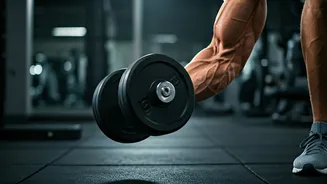









Understanding the Phases of a Lift
Every exercise you do has two main phases. Let’s use a simple bicep curl as an example. The ‘concentric’ phase is when the muscle shortens under tension—that’s when you’re lifting the dumbbell towards your shoulder. This is the part everyone focuses on.
But then there’s the ‘eccentric’ phase, which is when the muscle lengthens under tension. In our example, this is when you are slowly lowering the dumbbell back to its starting position. Most people rush this part, letting gravity do the work. This is a massive missed opportunity. The eccentric portion, often called the 'negative', is where much of the magic for muscle growth and strength happens.
Why Eccentrics Are a Game Changer
So, why is this lengthening phase so important? Your muscles are actually stronger during the eccentric phase than the concentric one. Studies have shown they can handle significantly more load while lengthening. This means that by controlling the negative, you create more microscopic tears in the muscle fibres. While 'tears' sound bad, this is the essential stimulus for muscle repair and growth, a process known as hypertrophy. By focusing on slow, controlled eccentric movements, you are creating a more potent signal for your body to build bigger, stronger muscles. It’s also a powerful tool for injury prevention and rehabilitation, as it strengthens tendons and improves your control over a full range of motion.
How to Incorporate Eccentric Training
The best part is that you don’t need to learn new exercises. You just need to change the tempo of your existing ones. The key is to make the lowering phase significantly longer than the lifting phase. A great starting point is the '3-1-1' tempo. This means you take three full seconds to lower the weight (eccentric), pause for one second at the bottom, and then take one second to lift the weight explosively (concentric). You can even extend the eccentric phase to four or five seconds for an even greater challenge. This deliberate slowness forces your muscles to work harder, recruits more muscle fibres, and dramatically increases the time your muscles are under tension—a key driver of growth.
Putting It into Practice
Let’s apply this to a few common gym movements: * **Squats:** After standing up from the bottom of the squat (concentric), take 3-4 seconds to slowly lower yourself back down (eccentric). Control the descent all the way. * **Bench Press:** After pushing the bar up, take 3-4 seconds to lower it back to your chest. Fight gravity; don’t let the bar just drop. * **Pull-Ups:** This is a classic. After pulling your chin over the bar, take as long as you can (aim for at least 3-5 seconds) to lower yourself back to a dead hang. If you can't do a full pull-up, just doing these 'negatives' is a fantastic way to build strength. * **Dumbbell Curls:** Once the weight is at your shoulder, take 3 seconds to lower it back down until your arm is straight, feeling the bicep stretch under load.
A Word on Soreness
There’s one thing you need to be prepared for: increased Delayed Onset Muscle Soreness (DOMS). Because eccentric training causes more muscle micro-trauma, it often leads to more soreness in the 24-48 hours after a workout. This is normal and a sign that you’ve created a powerful stimulus for growth. However, it’s also a reason to introduce this technique gradually. Don't switch your entire workout to eccentrics overnight. Start by applying the principle to the last set of one or two exercises. As your body adapts, you can incorporate it more widely. Listen to your body, ensure you’re getting adequate rest and nutrition, and enjoy the new level of strength and growth you unlock.