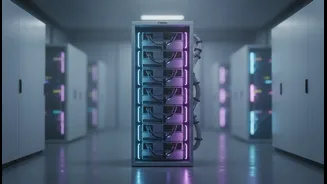







From Digital Code to Physical Reality
For years, the most powerful artificial intelligence models were developed in the pristine, controlled environments of specialist labs. Think of the research divisions at big tech firms, where brilliant minds had nearly limitless access to computing power.
In this context, an "advanced model" is a complex system, like a large language model, trained on vast datasets to perform tasks that traditionally required human intelligence. These digital creations, however, are not weightless. They are built and run on a physical foundation of specialized hardware and software known as AI infrastructure. This includes everything from the processors that perform trillions of calculations per second to the high-speed networks and storage systems that feed them data. In the lab, this infrastructure is optimized and abundant. But the AI world is changing. These models are no longer just research projects; they are being deployed in the wild by startups, enterprises, and smaller organizations that lack the resources of a tech giant.
The Unseen Engine of AI
At the heart of modern AI infrastructure is the Graphics Processing Unit, or GPU. Once known for rendering video game graphics, these chips excel at the parallel processing required to train and run massive AI models. Companies like Nvidia have achieved staggering dominance, with some estimates putting their market share for data center AI chips between 70% and 95%. This hardware doesn't exist in a vacuum. It lives in massive data centers that have voracious appetites for electricity and water. A single rack of AI servers can consume as much power as dozens of homes, and the largest AI data centers are approaching the power demands of a small city. The International Energy Agency projects that electricity demand from data centers could more than double between 2022 and 2030, driven largely by AI. This immense energy draw is needed not just to power the chips, but also to cool them, which often requires enormous quantities of water.
Leaving the Lab: The Infrastructure Gap
When an advanced model moves beyond the lab, it confronts a harsh reality. The meticulously clean data it was trained on is replaced by messy, real-world information. The perfectly configured hardware environment is gone, replaced by whatever infrastructure a company can afford or access. This creates a significant gap. Many organizations find that their existing IT systems simply cannot handle the computational demands of production-grade AI. The challenges are numerous: scaling models to handle increasing user loads, minimizing latency for real-time applications, and constantly monitoring performance for degradation. For many businesses, especially smaller ones, the high cost and scarcity of high-performance GPUs present a major barrier to entry. This reliance on a few cloud providers and one dominant chipmaker creates bottlenecks and raises costs for everyone else trying to innovate.
A New Arena for Global Competition
The concentration of power in AI infrastructure has not gone unnoticed by world governments. The hardware that powers AI—specifically advanced semiconductors—has become a central piece in geopolitical power struggles. Nations are increasingly viewing control over the chip supply chain as a matter of national security and economic competitiveness. The United States, for instance, has implemented stringent export controls to limit China's access to high-end AI chips and manufacturing technology. This techno-nationalism highlights a fundamental truth: a nation's ability to develop and deploy AI at scale is directly tied to its access to this critical infrastructure. For countries like India, the race for AI supremacy presents both a challenge and an opportunity, as the domestic IT industry navigates the impact of AI on everything from revenue streams to workforce planning. The global AI boom is being built on a shaky geopolitical foundation, where access to hardware can be granted or denied based on strategic interests.