







The Imaginary Heart of Reality
Since its inception in the 1920s by pioneers like Erwin Schrödinger, quantum mechanics has been puzzling. At its core is the description of the subatomic world using wave functions, mathematical tools that predict the behaviour of particles. But these
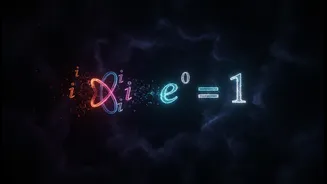
equations have a strange feature: they depend on complex numbers. A complex number is a combination of a regular 'real' number (like 3) and an 'imaginary' number, which is a multiple of the square root of -1 (like 4i). Engineers might use them for convenience to describe waves or electrical currents, but physicists have long debated if they are just a handy tool or a fundamental part of nature. For decades, it seemed they were essential to capture both the amplitude and phase of a quantum state, with a 2021 study even suggesting that a theory using only real numbers would fail experimental tests.
Challenging a Core Assumption
Now, a new study published in the journal Physical Review Letters offers a different perspective. A team of physicists from Germany's Heinrich Heine University Düsseldorf and the German Aerospace Center has successfully built a version of quantum mechanics using only real numbers. This new formulation makes all the same predictions as the standard theory, settling a long-simmering debate. According to the researchers, this shows that complex numbers are not fundamentally necessary to describe quantum reality. Instead, they can be seen as a convenient shorthand rather than an indispensable feature of the universe. This brings quantum theory more in line with other areas of physics where complex numbers are used for convenience but aren't considered essential.
How the New Model Works
The breakthrough came from re-examining a key assumption. The 2021 study that seemed to prove complex numbers were necessary relied on a standard mathematical rule for combining quantum systems, known as the tensor product. The authors of the new paper, including Pedro Barrios Hita and Professor Dagmar Bruß, found that this rule was more restrictive than it needed to be. They developed an alternative, physically motivated approach to combine quantum systems. Essentially, their method works as a clever bookkeeping system. Since a complex number is just a pair of two real numbers, their model tracks these two values separately instead of bundling them into one complex entity. This allowed them to build a consistent theory with only real numbers that produces the exact same experimental predictions as standard quantum mechanics.
What This Means for Physics
So, does this change everything? Not exactly. The new formulation doesn't point to new quantum technologies or change any experimental predictions, at least for now. Both the complex-number and real-number versions of the theory are experimentally indistinguishable. What it does change is our fundamental understanding. It shows that the mathematical language we have used for a century to describe the universe is not the only one possible. The 'weirdness' of needing imaginary numbers to describe tangible reality was a philosophical puzzle, and this work suggests it may have been a mathematical choice, not a physical necessity. For physicists, it provides a new and potentially simpler foundation to explore the quantum world. The next step for researchers is to extend this real-number framework to more complicated systems, which could reveal deeper insights into the structure of our universe.