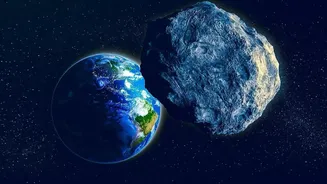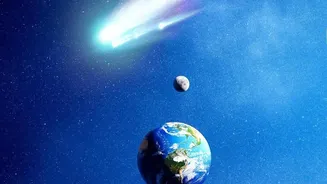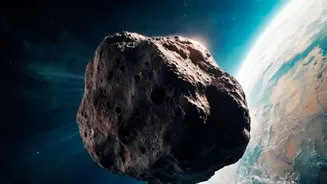





Earth has a new, temporary neighbor. A tiny asteroid named 2026 QQ8 has recently been nudged into an unusual orbit, making it a short-term companion to our planet. So what exactly is this cosmic visitor, and how long will it be sticking around?
Meet Our New Mini-Moon
Astronomers
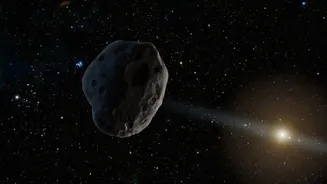
monitoring the skies have confirmed the arrival of a fascinating new object in Earth’s vicinity. Dubbed 2026 QQ8, this small asteroid, estimated to be just 15 to 20 metres in diameter, has entered a special orbital state that makes it a temporary 'mini-moon' or 'quasi-satellite' of Earth. Discovered in late October by the Pan-STARRS survey telescope in Hawaii, the object was initially flagged for its unusual trajectory. Further observations over the past few weeks confirmed that it wasn't just flying by; it was settling into a complex, corkscrew-like orbit tethered to our own planet's journey around the Sun. This isn't a moon in the traditional sense, like our own large Moon, but its path is now intimately linked with ours.
What Is a Quasi-Satellite?
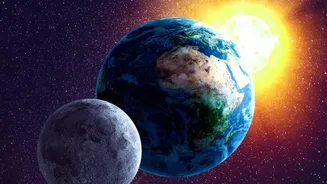
The term 'quasi-satellite' can be a bit misleading. Unlike our Moon, which is gravitationally locked and orbits the Earth, 2026 QQ8 is still primarily orbiting the Sun. However, its orbit is so similar to Earth’s—taking almost exactly the same amount of time to circle the Sun—that it has fallen into a 1:1 orbital resonance with our planet. Think of it like two runners on a circular track moving at nearly the same speed. For a long time, they'll stay relatively close to one another. From our perspective on Earth, 2026 QQ8 will appear to trace a strange, elongated loop around our planet over the course of a year. It's a delicate gravitational dance where the asteroid is constantly playing catch-up or falling slightly behind Earth, all while being gently nudged by our planet's gravity, keeping it from straying too far.
Close, But Not Too Close
The immediate question for any near-Earth object is, naturally, 'is there any danger?'. In the case of 2026 QQ8, the answer is a definitive no. While its orbit brings it into our planetary neighborhood, it remains at a safe and significant distance. At its closest point, the asteroid will still be millions of kilometres away, far beyond the orbit of our own Moon. Its 'companion' status is based on its orbital period, not its proximity. The gravitational pull that keeps it in this quasi-satellite state is subtle and works over vast distances. So, while it's a fascinating subject for scientific study, it poses zero threat of impact to our planet. Astronomers will use this opportunity to study a near-Earth object up close without having to launch an expensive mission.
A Fleeting Cosmic Visitor
The 'short-lived' part of the headline is key. The orbits of quasi-satellites are inherently unstable. The very gravitational perturbations from Earth and other planets that guide them into these paths will eventually push them out. According to preliminary orbital models, 2026 QQ8 likely entered this companion orbit sometime in the late 2010s and is projected to remain with us for another decade or so. Sometime in the late 2030s, its path will diverge, and it will drift back into a more conventional orbit around the Sun, leaving Earth's gravitational influence behind. This fleeting relationship gives scientists a limited but valuable window to observe the dynamics of how small bodies interact with larger planets in our solar system.
We've Had Companions Before
While the arrival of 2026 QQ8 is exciting news, it’s not the first time Earth has had a temporary sidekick. Several other asteroids have held the title of quasi-satellite over the years. One of the most well-known is Kamo'oalewa (469219), a slightly larger object that has been in a stable quasi-satellite orbit for nearly a century and is even the target of a planned sample-return mission by China. Another object, 2023 FW13, is believed to have been a companion for over two thousand years. Each of these objects provides a unique piece of the puzzle, helping scientists understand the complex and ever-changing environment of our solar system. These visitors serve as a powerful reminder that our cosmic neighborhood is far from empty and is filled with dynamic and interesting events.