




The Unseen Gravitational Tug
Imagine a parent and child holding hands and spinning in a circle. While the child travels in a large circle, the larger parent doesn't stay perfectly still. They also move in a small circle, pulled by the child's weight. A star and its planet behave
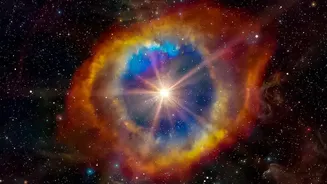
in exactly the same way. They both orbit a common center of mass. Because the star is vastly more massive, its 'orbit' is just a tiny, almost imperceptible wobble. For astronomers, this wobble is a giant clue. Detecting this movement means an unseen object, likely a planet, must be gravitationally tugging on the star.
Method 1: The Wobble of Light
The most successful method for detecting this stellar wobble is called the radial velocity or Doppler spectroscopy method. It doesn't track the star's position in the sky, but rather its movement towards or away from us. Think of the changing pitch of an ambulance siren. As it races towards you, the sound waves are compressed, making the pitch higher. As it moves away, the waves stretch out, making the pitch lower. Light behaves similarly. When a wobbling star moves slightly towards Earth in its tiny orbit, its light waves are compressed, shifting towards the blue end of the spectrum. When it moves away, its light shifts towards the red end. By measuring these tiny, cyclical shifts in the star’s light, astronomers can deduce that it is being pulled back and forth by an orbiting planet.
Method 2: Charting the Star's Path
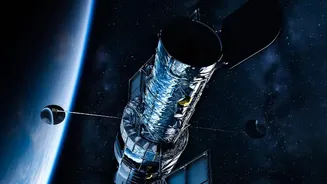
Another technique, called astrometry, is more direct but also much harder to perform. Instead of looking for shifts in light, astrometry involves trying to directly measure the star's tiny circular or elliptical path against the backdrop of more distant, fixed stars. This is like trying to spot the wobble of a pinhead from kilometres away. The movement is so minuscule that it is at the very limit of our current technology's ability to detect. However, as telescopes and instruments become more powerful, especially space-based observatories like the Gaia mission, astrometry is becoming an increasingly valuable tool. It works best for very large planets orbiting far from their stars, which complements the radial velocity method that is better for detecting massive planets orbiting closely.
What the Wobble Reveals
This stellar dance is more than just a detection method; it's a treasure trove of information. The timing of the wobble tells us the planet's orbital period, or how long it takes to complete one 'year'. The size of the wobble gives us a sense of the planet’s mass. A more massive planet will exert a stronger gravitational tug, causing a larger and more obvious wobble in its parent star. By combining this information, scientists can start to build a profile of the unseen world. They can determine a minimum mass for the planet and calculate the size of its orbit, which helps them understand if the planet lies in the 'habitable zone' where liquid water might exist.