


A Sun's Gaseous Ghost
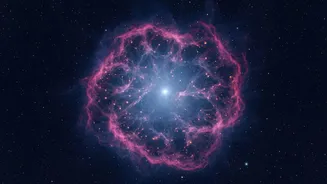
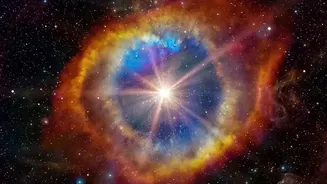
First, let's set the scene. The Helix Nebula is what astronomers call a planetary nebula—a slightly misleading name, as it has nothing to do with planets. It's actually the spectacular, glowing remains of a dying star similar to our own sun. As the star ran
out of fuel, it puffed its outer layers into space, creating intricate shells of gas and dust. At its heart lies the star's tiny, super-hot core, called a white dwarf, which illuminates the expelled gas like a cosmic neon sign. Because it's one of the closest planetary nebulae to Earth, astronomers have long used it as a laboratory to study the final life stages of Sun-like stars.
The Mystery of the Knots
When the Hubble Space Telescope first got a clear look, it revealed something strange lining the nebula's inner ring: thousands of dense, tadpole-shaped globules. Dubbed "cometary knots" for their bright heads and long, streaming tails, these objects are gigantic, with each head easily twice the size of our solar system and tails stretching for billions of miles. There are an estimated 40,000 of them in the Helix Nebula alone. The puzzle was one of survival. The nebula is a harsh environment, blasted by intense ultraviolet radiation from the central white dwarf. Scientists couldn't figure out how these delicate-looking structures could withstand this onslaught without simply evaporating.
Webb's Infrared Vision Changes Everything
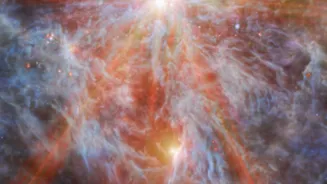
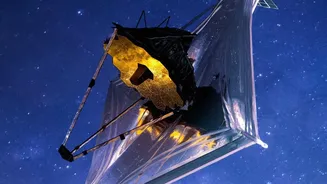
This is where the James Webb Space Telescope (JWST) enters the story. Unlike Hubble, which primarily sees visible and ultraviolet light, Webb is a master of the infrared spectrum. This allows it to peer through dust and detect the faint glow of cooler molecules that are invisible to other telescopes. When Webb aimed its powerful Near-Infrared Camera (NIRCam) at the Helix Nebula, it provided the clearest view yet, resolving the knots with stunning clarity. More importantly, it detected something Hubble couldn't see: the presence of cooler molecular hydrogen in the knots. This discovery was the key to solving the mystery.
An Invisible Molecular Shield
The science behind the knots' survival turns out to be a clever form of self-preservation. Webb's observations revealed that the knots are shielded by their own material. The outer layers of gas and dust, particularly molecular hydrogen, act as a protective barrier. This molecular shield absorbs the most destructive high-energy radiation from the central star. By taking the brunt of the impact, the outer layer protects the more fragile molecules deeper inside the knot's head and allows the long, dusty tail to form behind it. In essence, the knots create their own sunscreen, which explains why they haven't been vaporized over the thousands of years they've existed. Webb's data beautifully shows the transition from the hottest, ionized gas being hit by radiation to the cooler, protected gas within these pockets.