





A Planet on the Move
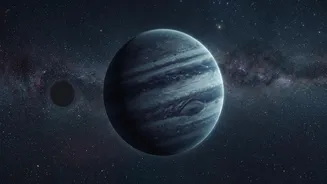
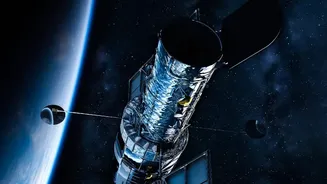
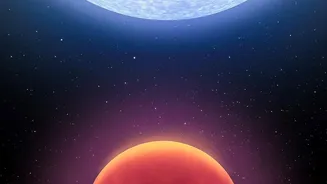
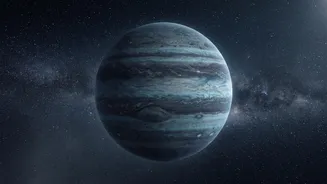
TOI-2535 b is a 'hot Jupiter', a gas giant similar in size to our own Jupiter but orbiting its star in a blisteringly fast 8.25 days. Astronomers first detected it using NASA's Transiting Exoplanet Survey Satellite (TESS), which finds planets by watching
for tiny, regular dips in a star's brightness as a planet passes in front of it. For seven years, from 2019 to early 2026, TESS watched TOI-2535 b make its transit. But the observations were never quite regular. The planet would arrive up to six hours early or late, and the dips in starlight grew shorter and fainter over time. Then, in March 2026, the transits stopped completely. The planet was gone.
The Unseen Neighbour
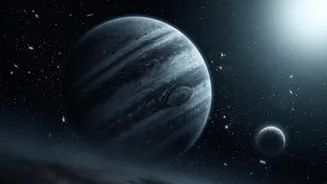
So, what happened? The planet didn't explode or get consumed by its star. The truth is far more interesting and reveals the dynamic, clockwork-like nature of the universe can be misleading. Researchers led by a team at UCLA concluded that TOI-2535 b is not alone. The erratic timing of its transits was a huge clue, pointing to the gravitational pull of a second, unseen planet in the same system. This hidden companion, thought to be at least the mass of Saturn, has a tilted orbit relative to TOI-2535 b. The two planets are locked in a gravitational dance, causing each other's orbits to wobble like a spinning top.
A Cosmic Disappearing Act
This orbital wobble is the key to the planet's disappearance. For TESS to see a transit, the planet's orbit must be perfectly aligned with our line of sight to its star. Over the seven years of observation, astronomers were watching in real-time as the gravitational tug from the neighbouring planet slowly tilted TOI-2535 b's orbit. Its path across the star shifted higher and higher until it was just grazing the star's edge, and then it missed the star entirely from our vantage point. The planet is still there, faithfully orbiting its star, but its path is now hidden from us. This makes it the first planet orbiting a single star to have its transit directly observed disappearing.
Why This 'Lost' Planet Matters
This discovery is more than just a cosmic magic trick. It provides a rare window into how planetary systems form and evolve. Hot Jupiters like TOI-2535 b are a puzzle because they are found so close to their stars, but theories suggest they must have formed much farther out. The presence of a massive, close-in companion suggests that TOI-2535 b may have migrated inward slowly over time, rather than being violently thrown into its current orbit after a near-collision with another planet. Systems with two giant planets orbiting so closely are unusual and challenge current models of planet formation, making this system a crucial laboratory for astronomers. While TOI-2535 b isn't expected to transit again for another 30 to 50 years, scientists are hopeful that its hidden companion might just wobble into view much sooner.