







From Pixels to Physical Action
Until recently, most of us interacted with AI as a digital tool. Generative AI creates content, while other forms predict outcomes based on data. Physical AI, also called embodied AI, is different. It’s a branch of artificial intelligence that gives machines
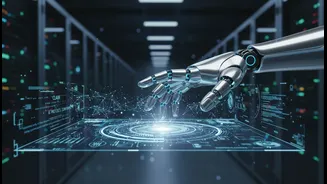
the ability to sense their environment, make decisions, and perform physical actions. Instead of just processing text or pixels, these systems use cameras, LiDAR, and other sensors to understand the world around them and interact with it using motors and actuators. Think of it as the difference between an AI that can describe how to pick up a box and one that can actually see the box, judge its weight, and physically lift it without dropping it. This leap from digital code to physical action is turning AI from a knowledge worker into an operational partner.
A New Breed of AI: The Robot Dog
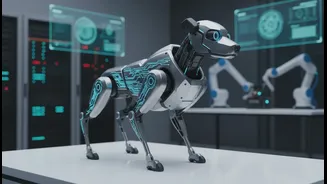
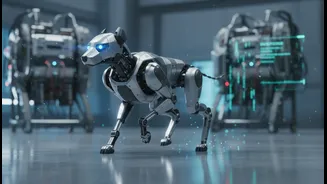
At the forefront of this revolution are quadrupedal robots, or robot dogs. Companies like Boston Dynamics have been pioneers, with their Spot robot demonstrating remarkable agility and versatility. Initially, these robots operated on pre-programmed routes. Now, thanks to advancements in physical AI, they are becoming truly autonomous. Google DeepMind, for instance, has been instrumental in teaching these robots to learn complex skills. Their research involves training robots in realistic simulations before deploying them in the real world, allowing them to learn from trial and error without the high cost of physical mistakes. By integrating advanced AI models, such as Google's Gemini, these robots can now interpret complex commands and reason about their tasks, a huge step up from simply following a path.
More Than Just a Pet Project
While the technology is fascinating, the business applications are transformative. The market for embodied AI is projected to grow from around $4.4 billion in 2025 to over $23 billion by 2030. Robot dogs are already being deployed in sectors that are hazardous or difficult for humans. In industrial settings, they conduct autonomous inspections of equipment, detecting gas leaks or thermal anomalies before they become critical failures. They navigate construction sites to monitor progress, map underground mines, and assist in search-and-rescue operations after disasters by traversing unstable rubble. In security, they can patrol large facilities or high-risk areas, providing 24/7 surveillance without fatigue. This automation boosts efficiency, improves worker safety, and provides more accurate data for decision-making.
The Challenges on the Path Forward
Despite the rapid progress, the road to widespread adoption has its hurdles. The physical world is infinitely more complex and unpredictable than a digital environment. A robot that performs perfectly in a lab may struggle when faced with changing light conditions, uneven surfaces, or unexpected obstacles in a real factory or disaster zone. This is known as the sim-to-real gap. Furthermore, hardware limitations like battery life, which is often just a few hours, and the high cost of these sophisticated machines remain significant barriers. There are also immense safety considerations; a robot operating in the physical world must have near-perfect reliability to avoid causing damage or harm. The complexity of integrating dozens of AI systems for perception, planning, and motion control into one seamless, reliable platform is a monumental engineering challenge.